
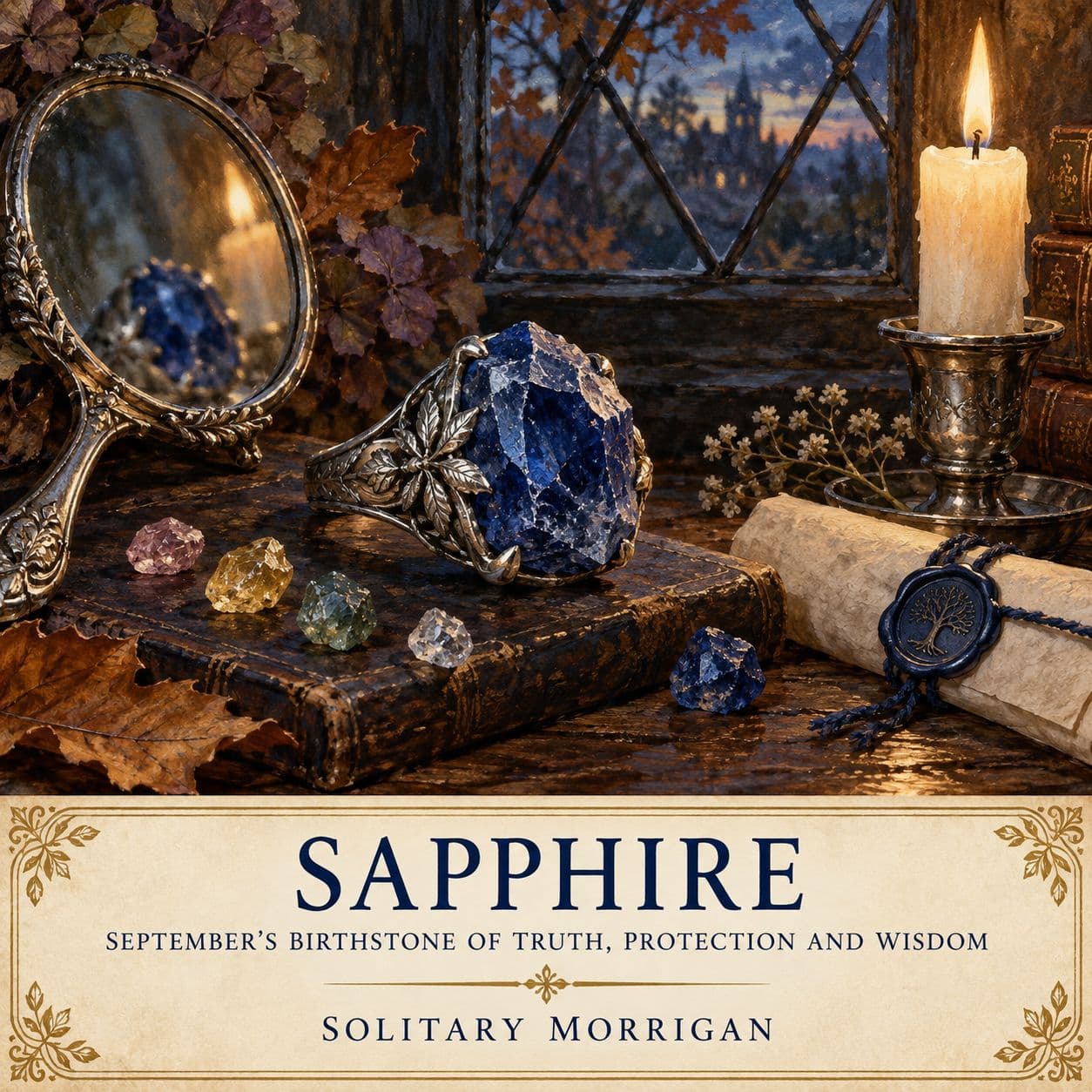
There are some crystals you can pick up and understand almost immediately. Rose quartz feels gentle, obsidian feels serious, and clear quartz seems to announce that it is ready to be used for practically anything. Sapphire is not quite like that. It has a more reserved quality. It does not give everything away on first acquaintance, which is probably one reason it has been connected with truth, wisdom, loyalty and hidden knowledge for so long.
Most people think of sapphire as a deep royal blue stone set into expensive jewellery. That is certainly its most famous form, but it is only part of the story. Sapphire can be yellow, pink, green, purple, orange, white and several shades in between. Some stones even change colour under different lighting. What joins them is not their appearance but the mineral beneath it: corundum, one of the hardest natural substances on Earth.
Sapphire is the traditional September birthstone, and I think it suits the month beautifully. September is a threshold. Summer has not entirely gone, yet autumn has begun to make itself known. The light changes, the evenings draw in and everything becomes a little clearer around the edges. Sapphire has that same sense of clarity and transition. It is a stone for seeing what is true, saying what needs to be said and remaining steady while circumstances change.
There is, however, a great deal of muddled information surrounding sapphire. Ancient stories are repeated as though every blue stone mentioned in an old text was the same mineral we now call sapphire. Modern crystal meanings are presented as unbroken traditions, and rather too many articles confidently describe the personality of everybody born in September. Stones have their own character, but they do not issue identical personalities to millions of people according to the month on a calendar.
So let us look at sapphire properly: what it is, why its history is more complicated than it first appears, what it has represented and how it can be used within witchcraft today.
What Sapphire Actually Is
Sapphire and ruby are members of the same mineral family. Both are gem-quality corundum, a crystalline form of aluminium oxide. When corundum is red, it is called ruby. Corundum of other gem colours is classed as sapphire, although blue remains the colour most people mean when they use the name without qualification.
The colour comes from tiny amounts of other elements within the crystal structure. In blue sapphire, iron and titanium play an important part. Chromium is involved in pink sapphire and, in a high enough concentration, produces the red colour that moves the stone into ruby territory. Yellow, green, violet and colourless sapphires have their own combinations and causes.
This matters magically because sapphire is not simply a blue crystal that occasionally turns up in other colours. The underlying stone remains corundum, but colour gives the practitioner another symbolic current to work with. A yellow sapphire may be chosen for confidence or prosperity, while a pink one may be used for tenderness and emotional truth. They belong to the same family without needing to perform exactly the same job.
Sapphire ranks nine on the Mohs scale of hardness, just below diamond at ten. That does not make it indestructible, because hardness refers mainly to resistance to scratching rather than an inability to chip or fracture. It does make sapphire unusually suitable for rings and jewellery intended to be worn often.
That physical durability is part of its magical character for me. Sapphire is associated with loyalty and lasting commitment, and unlike many crystal correspondences, that symbolism has a beautifully tangible foundation. It is a stone formed under pressure that can survive years of daily wear. If I were choosing a gem to represent a promise intended to endure, that makes far more sense than selecting something fragile simply because a correspondence list called it romantic.
The Complicated History of the Name Sapphire
One of the most important things to understand is that the word sapphire has not always meant modern blue corundum.
The name travelled through Greek and Latin forms, but ancient and medieval writers often used it for a rich blue stone flecked with gold. That description strongly suggests lapis lazuli, with its blue body and sparkling pyrite inclusions, rather than transparent blue sapphire. Ancient people classified stones by appearance, origin and received tradition. They did not have modern gemmological equipment, so familiar gemstone names could cover materials we would now separate completely.
This creates a problem when we read claims about the ancient magical properties of sapphire. A blue stone in an old source may indeed have been revered for protection, heavenly favour or divine wisdom, but it may not have been the crystal sold as sapphire today. It is more honest to say that some of the symbolism belongs to a long tradition of sacred blue stones, which was eventually attached specifically to sapphire as mineral identification became more precise.
That does not make the history worthless. Quite the opposite. It shows why the colour blue held such power. Deep, lasting blue is relatively unusual in the natural world. It evokes the sky at dusk, deep water and the apparent distance of heaven. A vivid blue gem seemed to carry that impossible colour in solid form.
Sapphire, Heaven and Sacred Authority
By the Middle Ages, sapphire had become closely associated with heaven, sacred truth and religious devotion in Europe. Clergy wore sapphires, and the stone appeared in rings, reliquaries and ecclesiastical objects. Blue could represent the heavens, while the gem’s clarity and durability supported ideas of purity, constancy and divine order.
Kings and nobles also adopted sapphire as a stone of authority, loyalty and protection. It was believed to guard against envy, deceit, poison and harm. Some of these beliefs now sound fantastical, particularly the idea that sapphire could act as an antidote to poison, but they tell us how seriously gems were once treated. Jewellery was not only decoration. A ring could signify rank, seal an agreement, preserve a relic, protect the wearer and declare allegiance all at once.
Sapphire’s association with fidelity also made it a natural stone for betrothal and commitment. The modern sapphire engagement ring did not invent that symbolism. It drew upon older ideas about loyalty, sincerity and promises made under sacred witness.
This is one reason sapphire works so well in oath and truth magick. The stone carries centuries of accumulated meaning around promises, honest speech and integrity. You do not need to believe that every medieval legend was literally true to recognise the magical weight of that history.
What Sapphire Means in Witchcraft
I would describe sapphire as a stone of disciplined truth. It does not simply expose information for the sake of curiosity. Its energy is better suited to understanding, wise speech, clear judgement and remaining faithful to what you know is right.
There is a difference between truth and bluntness. Some people pride themselves on “telling it like it is” when what they actually enjoy is saying hurtful things without consequence. Sapphire is not about that. It supports speech with purpose, honesty with self-control and the ability to say something difficult without turning it into a weapon.
That makes it useful when you need to have an important conversation, give evidence, set out a boundary or explain your position without being pulled off course. It is also valuable when the person you most need honesty from is yourself.
Sapphire can help with mental focus and discernment, particularly when emotion, wishful thinking or outside pressure has made a situation difficult to read. Its energy is cool rather than cold. It settles the noise sufficiently for the important detail to become visible.
It is also a protective stone, but not usually in the same way as black tourmaline or obsidian. Sapphire protection is linked with integrity, alertness and spiritual authority. It helps you recognise deceit, remain clear about your own values and avoid being drawn into confusion. Sometimes the strongest protection is noticing the lie before you build your life around it.
Blue Sapphire for Truth and Wisdom
Blue sapphire is the form most closely associated with truth, wisdom, loyalty, spiritual insight and clear communication. Modern chakra systems commonly connect it with the throat and third eye because of its colour and traditional meanings. It can be used when you need to speak truth, receive insight or bring thought and expression into alignment.
I particularly like blue sapphire for divination that has become emotionally tangled. Place it beside the tarot deck or scrying bowl with the specific intention that you will see the situation as it is, rather than as you fear or hope it might be. This does not make every reading infallible. It establishes the standard you are asking yourself and spirit to meet.
It is also a good stone for study, research and any work requiring sustained concentration. Sapphire does not have the quick, busy feel often associated with Mercury. It is more measured. It suits learning that must be absorbed properly, difficult material that deserves patience and knowledge that carries responsibility.
Pink, Yellow, Green and White Sapphire
Modern magical practice often gives each sapphire colour its own emphasis. These meanings are not all ancient, fixed correspondences, but they are sensible ways to combine the nature of sapphire with colour symbolism.
Pink sapphire brings the stone’s honesty and constancy into emotional matters. I would use it for truthful affection, healing after betrayal, self-respect in relationships and promises made from genuine feeling. It is not as soft as rose quartz. There is more backbone to it, which makes it useful when love needs honesty as much as comfort.
Yellow sapphire is commonly associated with prosperity, confidence, opportunity and wise decision-making. In Vedic astrology, yellow sapphire has a separate and important connection with Jupiter, while blue sapphire is linked with Saturn. These are specific astrological traditions, not general rules that every witch must adopt. If you are working outside that system, yellow still combines sapphire’s clarity with the solar and prosperous symbolism of gold and yellow.
Green sapphire suits growth, loyalty to a developing purpose, healing and clear-hearted decision-making. It can support a business, creative project or relationship that needs patient cultivation rather than a sudden burst of energy.
White sapphire is useful for purification, spiritual focus and clean intention. It can substitute symbolically for blue sapphire when the work is about truth without an emotional or communicative emphasis. Because it resembles diamond, it is sometimes sold as a diamond alternative, but it has its own identity and should not be treated as a lesser version of another stone.
Black sapphire is less commonly discussed in beginner crystal books, yet it can be used for firm protection, grounding and keeping one’s counsel. Star sapphires, which display a moving star-like effect across the surface, naturally lend themselves to guidance, fate, spirit work and finding direction when circumstances are unclear.
Sapphire and September Birthdays
Sapphire is the recognised birthstone for September and is also traditionally used for certain wedding anniversaries. Birthstones are now so familiar that it is easy to assume the current month-by-month list has existed unchanged since antiquity. In reality, birthstone traditions developed from several older systems and were standardised much later.
That does not make a September sapphire less meaningful. Birthstones work partly because they connect a person with a shared tradition. A sapphire given for a September birthday carries the intention of truth, protection, wisdom and loyalty. Those are powerful blessings whether the recipient is a Virgo, a Libra or somebody who has never looked at a birth chart in their life.
I would avoid claiming that everybody born in September is naturally calm, loyal and practical. I have met enough people to know that birthdays do not hand out good character automatically. A birthstone is better understood as an ally or blessing. It may strengthen qualities the person values, remind them of what they want to embody or mark their place within the turning year.
For Virgo, sapphire’s clarity and disciplined focus can complement an analytical nature while encouraging the mind to stop circling a problem endlessly. For Libra, its links with truth, balance and faithful partnership can be especially appropriate. These are modern astrological applications, but they can still be useful when approached thoughtfully rather than as rigid personality rules.
Sapphire in Saturn and Planetary Work
Blue sapphire has a formidable reputation in Vedic astrology because of its association with Saturn. Traditional practitioners may advise that it should be prescribed according to the birth chart rather than worn casually as a planetary remedy. That warning belongs within a complete astrological system, where the condition and rulership of Saturn are carefully assessed.
Western crystal books sometimes borrow the dramatic warning while leaving out the system that gives it meaning. The result is people becoming frightened of a piece of jewellery they have worn happily for years. If you are deliberately using blue sapphire as a Vedic astrological remedy, consult somebody properly trained in that tradition. If you are carrying a small sapphire for truth or wearing a September birthstone because you love it, that is not automatically the same operation.
In Western planetary magick, sapphire correspondences have varied. Some associate blue sapphire with Saturn because of its depth, discipline and permanence, while others place particular blue stones with Jupiter for wisdom, authority and the heavens. The intended work matters. I would not force a stone into one planetary box when its history and colour allow more than one meaningful relationship.
Using Sapphire in Spellwork
Sapphire is usually expensive, so there is no sense treating a valuable stone roughly to prove that you are serious about magic. Do not bury a sapphire ring in damp soil, cover it in candle wax, soak it in oils or drop it into salt. The corundum may be hard, but the setting, treatment and other materials in the jewellery may not be.
For truth work, place the sapphire beside a blue or white candle and write the matter plainly on paper. Ask that deception, including self-deception, be removed and that the truth become clear in a way you can understand and act upon. Keep the stone separate from flame and wax.
For honest communication, hold the stone before a difficult conversation and decide what actually needs to be said. You are not asking it to make the other person agree with you. You are using it to steady your voice, keep your account clear and stop fear from making you abandon the point.
For loyalty or commitment work, sapphire can sit beside two linked candles, a written vow or a photograph. The intention should define what loyalty means. Fidelity, consistency, mutual protection and keeping one’s word are related, but they are not identical.
For divination, place the sapphire near your cards or mirror and ask for clarity without comforting distortion. After the reading, write down what appeared before trying to make it more pleasing. Sapphire is particularly useful when you already suspect the answer and need the courage to acknowledge it.
For protection, a sapphire pendant or ring can be charged to guard your judgement, reveal dishonest intentions and keep you aligned with your own authority. It works well for meetings, negotiations, legal matters and any situation in which careful words carry weight.
A Simple Sapphire Truth Ritual
You will need a sapphire or sapphire-set piece of jewellery, a blue or white candle, a glass of clean water and a small piece of paper. A modest stone is perfectly adequate. Magick does not improve according to the retail price of the crystal.
Place the water in front of the candle and the sapphire beside it. Write one question or situation on the paper. Keep it specific. “What am I refusing to see about this relationship?” is more useful than “Tell me everything.” Fold the paper once towards you and place it beneath the glass.
Light the candle and hold the sapphire. Speak aloud that you are asking for truth, sound judgement and the strength to accept what is shown. Look into the water for a few minutes without straining for visions. Pay attention to thoughts, memories and details that surface. If nothing dramatic happens, that does not mean the ritual has failed. Clarity often arrives afterwards, through a conversation, dream or pattern that becomes impossible to ignore.
Let the candle burn safely for a suitable time, then extinguish it. Keep the sapphire with you for the next few days and record anything relevant. Pour the water away when the work feels complete. The value lies in what becomes clear and what you choose to do with that clarity.
Buying Sapphire Without Being Misled
Natural sapphire can be costly, particularly when the colour, clarity, size and origin are desirable. Heat treatment is extremely common and is used to improve colour or clarity. Other treatments include lattice diffusion, where colouring elements are introduced into the stone. Treatments are not automatically bad, but they should be disclosed because they affect value and sometimes care.
Laboratory-grown sapphire is genuine corundum created by people rather than geological processes. It shares the essential chemical and physical properties of natural sapphire. An imitation is different: it may be glass or another material chosen only because it looks similar. Sellers should describe these things accurately.
For magical work, you may personally prefer an untreated natural stone, while somebody else may connect perfectly well with laboratory-grown sapphire. I care far more about honesty than snobbery. A clearly labelled synthetic stone sold at a fair price is preferable to coloured glass being passed off as rare natural sapphire.
If you are spending serious money, ask whether the stone is natural or laboratory-grown, what treatments it has received and whether there is an independent gem report. Be wary of large, flawless, intensely coloured “natural sapphires” offered for very little. Miracles do happen, but they are remarkably rare in online jewellery listings.
Cleansing and Caring for Sapphire
Sapphire is durable, but the safest magical cleansing methods are often the simplest. Wipe it gently with a soft cloth, pass it briefly through incense if suitable, place it in moonlight or set it beside a bowl of water rather than immersing it. Sound and focused intention are useful when you do not know how a stone or piece of jewellery has been treated.
Warm soapy water is generally suitable for many sapphires, but jewellery settings and fracture-filled or treated stones may require particular care. If the piece is valuable or its treatment is unknown, follow professional advice rather than experimenting with salt, boiling water, chemicals or ultrasonic cleaners.
Energetically, I cleanse sapphire after using it in difficult truth work, legal matters or emotionally charged divination. I do not cleanse it compulsively after every brief touch. A working stone develops a relationship with its owner, and constantly stripping it back because an online post said crystals absorb everything can prevent that relationship from settling.
Sapphire as a Stone of Truth
Sapphire’s power does not come from one perfect ancient tradition. It comes from several layers held together: the physical endurance of corundum, the rarity and depth of blue, centuries of sacred and royal use, and the long belief that this stone protects truth, loyalty and wise judgement.
The history becomes more interesting, not less, when we admit that some ancient “sapphires” were probably lapis lazuli. It reminds us that magical meaning does not belong only to chemical composition. Colour, story, use and human reverence all leave their mark.
As September begins to turn the year towards autumn, sapphire offers exactly the sort of power the season needs. It helps us look clearly at what remains, what is changing and what can no longer be disguised. It supports promises that deserve to last and truths that need a steady voice.
It is not a stone of empty reassurance. Sapphire does not tell you that everything is fine when it is not. It asks for honesty, then gives you something solid to hold while you face it.
Personally, I think that is far more valuable than sparkle alone.