
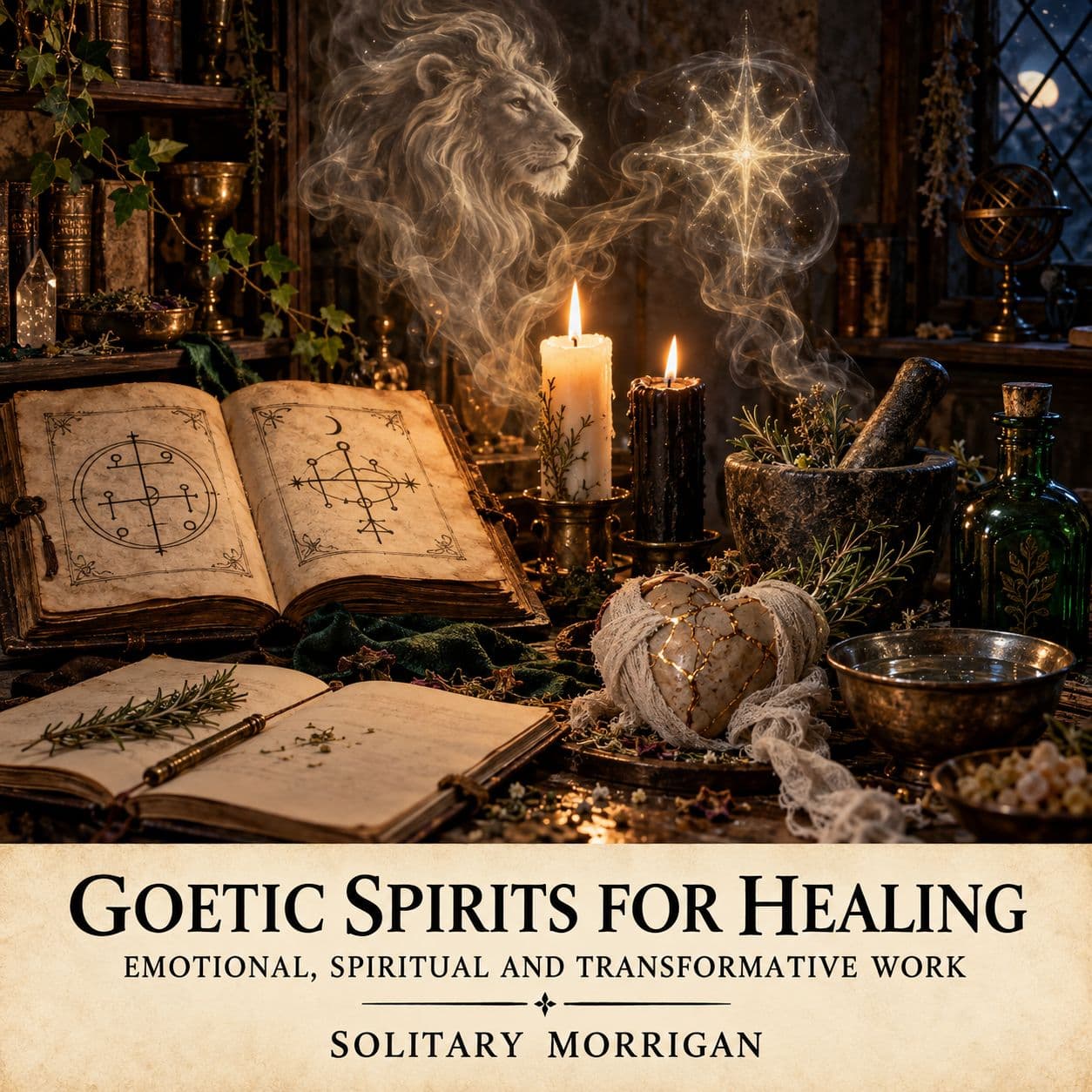
Healing is probably not the first thing most people associate with the Goetia.
Mention Goetic spirits and people tend to think of power, lust, control, wealth or revenge. They rarely imagine healing, partly because popular culture has spent years presenting every demon as a destructive force with no purpose beyond frightening or corrupting human beings.
The grimoires themselves tell a more complicated story.
Among the seventy-two spirits of the Ars Goetia are demons who cure illness, teach the virtues of plants, reconcile enemies, reveal hidden thoughts, restore lost dignity and transform one substance into another. The old text does not describe these abilities using modern language such as trauma recovery, emotional regulation or spiritual healing, but the foundations are certainly there.
Some Goetic spirits have an unmistakable connection with healing. Others possess powers that can be applied to emotional wounds, limiting beliefs, lost confidence and spiritual stagnation.
Their healing is not always gentle. They may reveal what caused the wound, expose the pattern keeping it alive and force the practitioner to acknowledge what needs to change. Yet that is precisely why the work can be so powerful.
What the Goetia Actually Is
The Ars Goetia is the first section of the Lemegeton, commonly known as the Lesser Key of Solomon. The surviving work was compiled during the seventeenth century, using earlier material that included Johann Weyer’s Pseudomonarchia Daemonum and Reginald Scot’s Discoverie of Witchcraft. Its catalogue contains seventy-two spirits, each with a rank, appearance, seal and set of powers or offices. esotericarchives.com
Modern practitioners frequently describe these spirits as ancient intelligences, teachers or individual spiritual beings. The historical grimoire presents them as infernal spirits to be conjured and constrained through ceremonial authority.
Those are two very different approaches.
I do not believe every modern practitioner must reproduce the exact threats and commands found in older ceremonial magic. My own relationships with daemonic spirits are based upon contact, understanding, offerings, clear instructions and respect.
However, we should still be honest about what the original text says.
The fact that the English word demon ultimately relates to the Greek daimōn does not prove that every Goetic spirit began as a benevolent pagan guide. Etymology alone cannot tell us the origin or true nature of all seventy-two spirits.
What we can do is study their recorded offices, combine that knowledge with experience and choose the spirit that genuinely fits the work.
What Goetic Healing Feels Like
Goetic healing rarely resembles being wrapped in a warm blanket and told everything will be all right.
These spirits tend to work by revealing, separating, strengthening or transforming. They may expose the real reason a wound continues to control you. They may draw attention to a relationship, habit or belief that keeps reopening it. They may restore confidence so that you finally act upon what you already know.
Sometimes the healing begins with relief. At other times, it begins with an uncomfortable truth.
A person asking to recover from heartbreak may first have to recognise that they were addicted to chasing somebody unavailable. Someone seeking confidence may discover how often they deliberately make themselves smaller to keep other people comfortable. A practitioner asking to feel spiritually connected again may be shown that their practice has become repetitive and empty.
This is not punishment. It is the removal of whatever prevents the wound from closing.
The spirit does not do all the work. Ritual creates movement, insight and opportunity, but the practitioner must respond. If a spirit reveals the pattern and you continue repeating it knowingly, the healing cannot fully settle.
Marbas: Healing, Diagnosis and Repair
Marbas is the fifth spirit of the Ars Goetia and one of its clearest healing figures.
He appears first as a great lion and later takes human form. The grimoire states that he reveals hidden or secret things, causes diseases and cures them, grants wisdom in mechanical arts and changes people into other shapes. esotericarchives.com
Marbas is often approached for physical healing, understanding an unexplained health problem and identifying what lies beneath persistent symptoms. His ability to both cause and cure disease gives him authority over the movement of illness rather than only its removal.
His connection with mechanical arts also matters. Marbas understands systems, structures and how one working part affects another. In healing magic, this can be applied to the body, but it also makes him useful when emotional or spiritual wellbeing has become a complicated system of reactions.
You may know that you feel anxious, angry or exhausted without understanding what keeps producing it. Marbas can help expose the mechanism.
He is particularly suited to work concerning:
- Physical healing and recovery
- Discovering the hidden source of a problem
- Restoring strength after illness
- Understanding repeated emotional reactions
- Repairing what has become damaged or disordered
- Changing the practitioner’s relationship with their body
Marbas should not be treated as a replacement for medical investigation or treatment. If something is physically wrong, seek proper care. Spirit work and ordinary treatment can support the same outcome.
Buer: Healing, Herbs and Restoring Stability
Buer is the tenth spirit and another demon explicitly connected with healing.
The Ars Goetia says that he teaches moral and natural philosophy, logic and the virtues of herbs and plants. Most significantly, he heals illnesses in people. esotericarchives.com
Buer’s healing feels structured. He is not only concerned with making a symptom disappear. His wider offices suggest knowledge, natural remedies, reason and the understanding of how life should be maintained.
This makes him particularly valuable when healing requires consistency.
Some people want a single dramatic ritual when what they actually need is help rebuilding the routines that support them. They need better rest, stronger boundaries, regular cleansing, nourishing food, appropriate treatment or the discipline to stop returning to whatever makes them unwell.
Buer can assist with:
- Physical recuperation
- Herbal knowledge
- Restoring spiritual discipline
- Rebuilding healthy routines
- Grounding scattered energy
- Recovering after emotional exhaustion
- Understanding the relationship between habits and wellbeing
His work can be calm without being passive. Buer may guide a practitioner towards very practical changes. The message may not be mysterious. It may be that you need to rest, take the medication properly, attend the appointment, leave the draining situation or stop treating exhaustion as a sign of spiritual dedication.
Practical healing is still healing.
Amon: Reconciliation and Healing Conflict
Amon is the seventh spirit and one with whom I have a particularly close relationship.
The grimoire describes him as a powerful Marquis who reveals things from the past and future, procures love and reconciles disputes between friends and enemies. esotericarchives.com
Reconciliation does not always mean restoring a relationship exactly as it was.
Sometimes healing requires two people to understand one another and rebuild their connection. Sometimes it means resolving the conflict sufficiently for both people to move forward. At other times, Amon’s work reveals that the relationship cannot be repaired without repeating the original harm.
His ability to reveal the past is important in emotional healing. Many present conflicts are being fuelled by something older. Words spoken during the latest argument may matter less than the years of resentment beneath them.
Amon can help uncover the real point at which trust broke down.
He may be approached for:
- Reconciliation between partners, relatives or friends
- Healing resentment after an argument
- Restoring communication
- Understanding the history beneath present conflict
- Softening hostility
- Recovering from betrayal
- Finding closure when reconciliation is not possible
Amon is powerful in matters where love still exists but has become buried beneath pride, anger, misunderstanding or interference.
His healing does not require pretending nothing happened. Genuine reconciliation needs the wound to be acknowledged before the relationship can be rebuilt.
Dantalion: Thoughts, Emotional Patterns and the Inner Narrative
Dantalion is the seventy-first spirit of the Goetia.
He appears with many faces and carries a book. His traditional offices include teaching arts and sciences, revealing people’s hidden thoughts, changing those thoughts, causing love and showing the likeness of people through visions. esotericarchives.com
The old text does not call Dantalion a healer. His relevance to emotional healing comes from his authority over thought.
Every emotional wound develops a story around it.
After betrayal, the story may become, “Nobody can be trusted.” After rejection, it may become, “I will never be chosen.” Following years of criticism, it may become, “I am incapable of succeeding.”
These thoughts do not remain harmless sentences. They shape behaviour, relationships and the opportunities a person believes they deserve.
Dantalion can help expose and change these internal narratives.
He is suited to work involving:
- Destructive thought cycles
- Obsessive thinking
- Emotional confusion
- Understanding another person’s perspective
- Identifying hidden motives
- Changing beliefs formed through past pain
- Recognising the difference between intuition and fear
His many faces provide a powerful image for this work. A person can carry countless versions of themselves, including the child who was frightened, the adult who became guarded and the future self who no longer wishes to live through the old wound.
Dantalion can help the practitioner see which face is speaking.
This work can bring buried thoughts to the surface. Journalling, divination and honest reflection are important afterwards because the healing does not finish when the ritual closes.
King Paimon: Knowledge, Dignity and Understanding the Wound
King Paimon is the ninth spirit and one of the most recognisable figures in the Goetia.
The grimoire says that he teaches arts, sciences and secret things, answers questions concerning the world and grants dignity. esotericarchives.com
Again, he is not described as an emotional healer in the old text. His value lies in knowledge and restored dignity.
Some wounds remain active because the person cannot understand what happened. They continue turning the situation over in their mind, trying to find the missing explanation. Others understand the event perfectly well but have lost their sense of worth because of it.
King Paimon can bring order to that confusion.
He can help reveal:
- Why a particular pattern keeps repeating
- What lesson has not yet been understood
- Where personal authority was surrendered
- Which information is missing
- How the practitioner can rebuild confidence
- What knowledge is required for the next stage of recovery
Dignity is an important but overlooked part of healing.
There comes a point when repeatedly asking why somebody mistreated you keeps your attention fixed upon them. Healing then requires the restoration of your own position. You stop begging the wound to explain itself and begin deciding what happens next.
King Paimon can assist with that shift from confusion to authority.
Haagenti: Transformation After the Wound
Haagenti is the forty-eighth Goetic spirit.
Traditionally, he grants wisdom, teaches different subjects, changes metals into gold and transforms water into wine and wine into water. esotericarchives.com
The grimoire does not explicitly connect him with emotional healing. His usefulness here comes from the nature of transformation itself.
Haagenti does not only elevate something base into something valuable. He also reverses the process, changing wine back into water. His power is control over condition, quality and state.
That makes him an excellent spirit for the stage of healing when the practitioner no longer wants simply to feel less pain. They want to become something different through what they have survived.
Haagenti may assist with:
- Transforming pain into wisdom
- Rebuilding identity after loss
- Breaking self-destructive habits
- Recovering confidence after failure
- Recognising value where others saw none
- Returning an overcomplicated situation to simplicity
- Creating a new life after profound change
There is a tendency to speak about transformation as though suffering automatically makes everyone wiser. It does not.
Pain can become wisdom, but only when it is processed, understood and used. Otherwise it remains pain.
Haagenti’s current can support the deliberate work of transmutation.
What About Asmodeus and Bael?
Asmodeus and Bael are often included in modern lists of spirits for emotional healing, but their traditional descriptions need to be kept separate from later practice.
Asmodeus is described in the Goetia as teaching arithmetic, geometry, astronomy and mechanical crafts. He provides truthful answers, reveals treasure and grants invisibility. The text does not say that he severs unhealthy attachments or heals heartbreak. esotericarchives.com
Modern practitioners may nevertheless experience him as a powerful spirit of desire, confidence, appetite, sexuality and personal freedom. Those qualities can certainly support recovery after shame, rejection or a relationship in which desire has been suppressed. That is a modern application rather than his stated Goetic office.
Bael’s traditional power is invisibility. The grimoire does not describe him as a healer, protector or spirit of emotional authority. esotericarchives.com
A modern practitioner might use his invisibility current to withdraw from unwanted attention, hide while recovering or prevent a harmful person from gaining access to their energy. Once again, that is an interpretation of his traditional power, not a healing office recorded in the text.
There is nothing wrong with developing new applications through experience. The problem begins when later interpretations are presented as though they were written in the seventeenth-century manuscript.
Choosing the Right Spirit
Do not begin by choosing the spirit you find most visually impressive.
Begin with the wound.
Ask what is actually happening:
- Is there a physical condition requiring healing or greater understanding?
- Are you emotionally attached to somebody who continues to hurt you?
- Is an old thought pattern controlling present behaviour?
- Has conflict damaged a relationship that still deserves repair?
- Have you lost confidence or personal dignity?
- Do you need to transform what happened into something useful?
Once the root is clear, the choice becomes easier.
Marbas suits diagnosis, repair and physical healing. Buer supports healing, herbs and restored structure. Amon addresses reconciliation and relational conflict. Dantalion works through thoughts, perceptions and emotional patterns. King Paimon brings knowledge and dignity. Haagenti supports deep transformation.
You do not need to call all of them.
One correctly chosen spirit with one clear request is far more effective than filling a ritual with names because you are afraid one will not be enough.
Structuring a Goetic Healing Working
A healing ritual should have a defined purpose.
“I want to heal” is too broad. What do you want to heal from? What does improvement look like? How will you recognise movement?
A more useful petition might ask:
- For Marbas to reveal the hidden source of a recurring problem and strengthen recovery.
- For Buer to restore physical and spiritual stability after illness.
- For Amon to remove resentment and reopen honest communication.
- For Dantalion to expose and change a destructive belief formed through betrayal.
- For King Paimon to reveal the lesson beneath a repeating pattern and restore dignity.
- For Haagenti to transform grief into wisdom and renewed purpose.
Prepare the ritual according to your usual practice. Cleanse the space, establish protection and place the spirit’s seal where it can be clearly seen.
Offerings should suit the relationship you have with that spirit. They may include incense, wine, herbs, candles, oils, written praise or something promised specifically through divination.
State the request plainly. You do not need to make pain sound poetic. Spirits respond to precision more readily than performance.
When the communication or petition is complete, give thanks, close the ritual properly and record what happened.
What Happens After the Ritual
Goetic healing may continue through dreams, emotional release, sudden realisations or changes in the external situation.
You might remember something you had avoided. A conversation may finally take place. Your tolerance for a damaging relationship may disappear. You may feel compelled to change a routine, make an appointment, set a boundary or return to a part of yourself that was abandoned.
Pay attention to practical instructions.
If the working brings up intense emotion, allow time for it to settle before performing another ritual. Do not immediately call a second spirit because the first experience felt uncomfortable.
Discomfort is not automatically evidence of harm. It may mean that something buried has surfaced. Equally, not every upsetting event after a ritual should be romanticised as necessary spiritual cleansing.
Judge the work by its direction.
Is it moving you towards stability, understanding and strength? Is it helping the wound close, or is it encouraging obsession and fear? Good spiritual healing should eventually create greater freedom, not permanent dependence upon ritual.
Goetic Healing and Ordinary Support
Spiritual work does not become less powerful because you also use practical help.
A person can work with Buer while receiving medical treatment. Dantalion can support the changing of destructive thoughts alongside counselling. Amon may help reopen communication, but the people involved still have to speak honestly.
The spirit opens a route. You still have to participate in the healing.
This is particularly important with trauma. Ritual may reveal and shift energetic patterns, but it should not be used as a reason to stop medication suddenly, ignore serious symptoms or remain in a dangerous situation.
Magic and ordinary action are not enemies.
Healing That Does Not Return You to the Past
People often imagine healing as becoming the person they were before something hurt them.
Goetic healing rarely works that way.
Marbas repairs, but he also changes form. Buer heals while teaching wisdom and structure. Dantalion changes thoughts. Haagenti transforms one substance into another. These are not currents of simple restoration.
The aim is not always to return to the old self.
Sometimes that person lacked the knowledge, boundaries or confidence needed to remain safe. Healing means becoming somebody who carries the experience without continuing to live inside it.
That may involve reconciliation. It may involve separation. It may mean forgiving yourself, rebuilding your health, reclaiming desire or finally refusing to repeat the same pattern.
Goetic spirits do not need to resemble gentle healers to facilitate genuine healing. Their strength lies in their willingness to expose what softer work may leave untouched.
When correctly chosen and approached with discipline, they can help reveal the wound, understand its machinery, remove what keeps feeding it and support the creation of something stronger in its place.
The spirit may open the door, but the healing becomes yours when you choose to walk through it.