
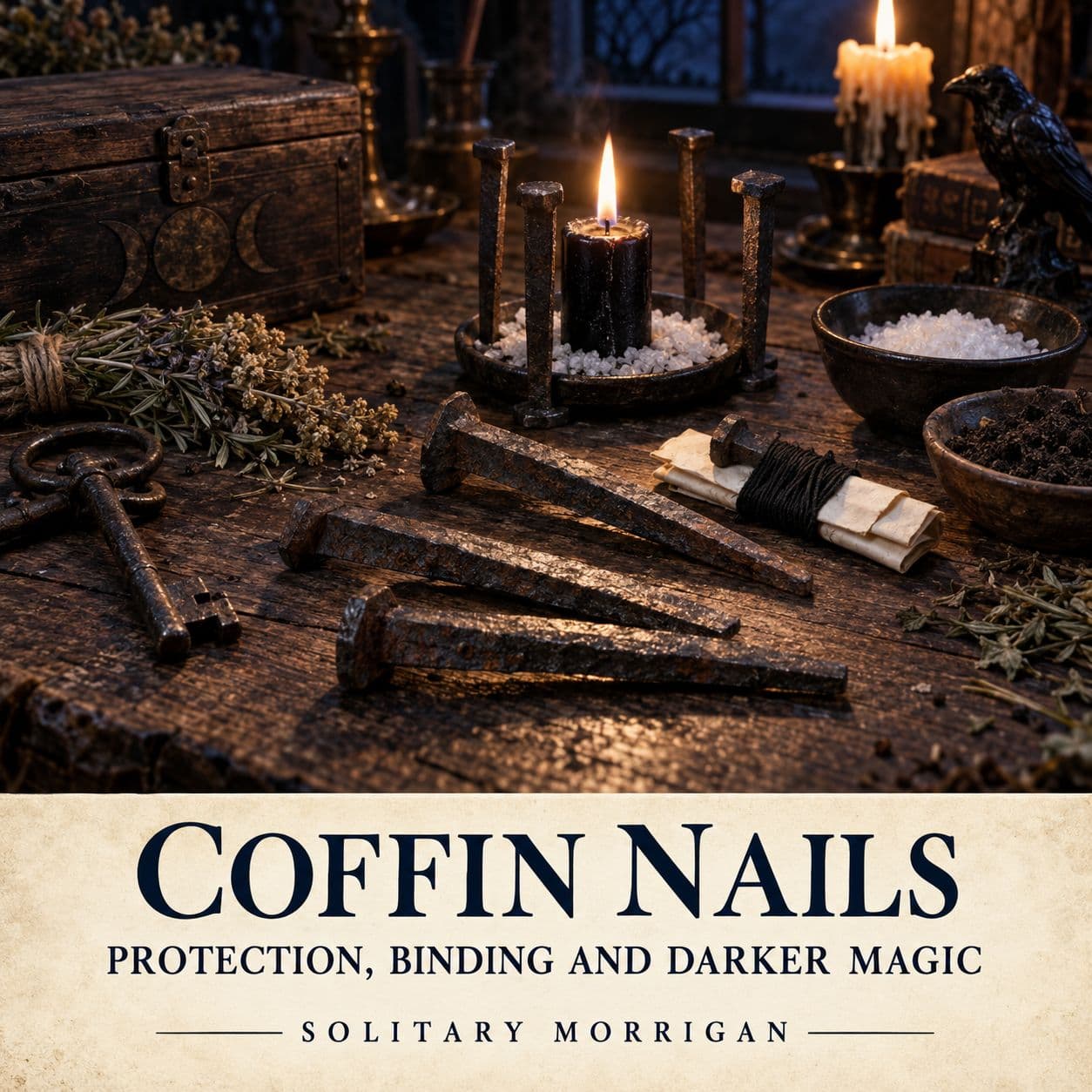
Coffin nails are one of those magical tools that immediately capture the imagination. Even somebody with no knowledge of witchcraft understands that a nail taken from a coffin carries a very different weight from one bought in a hardware shop.
They have associations with death, burial, endings and the physical act of fastening something shut. In magic, those associations make them useful for protection, binding, closure, spirit work and more destructive workings. They are not gentle tools, but that does not mean every spell involving a coffin nail is intended to cause harm.
Personally, I think coffin nails are often presented far too theatrically. You will see them described as though simply owning one gives you command over the dead. That is not how I understand them. Their strength comes from several things working together: the nature of iron, the purpose the nail once served, its contact with death and the intention placed upon it by the witch.
There is also an important difference between a genuine coffin nail and a modern nail prepared for magical use. Both can be useful, but they are not automatically the same thing.
What Is a Coffin Nail?
Traditionally, a coffin nail was exactly what its name suggests. It was an iron nail used in the construction or fastening of a coffin. Older coffins were commonly assembled using hand-forged or square-cut nails, although their size and appearance varied considerably.
An authentic coffin nail would therefore be a nail known to have come from a coffin. It might have been recovered during legitimate archaeological work, found among old undertakers’ materials or obtained from a damaged historical coffin with the proper authority.
Many objects sold today as coffin nails have never been near a coffin. Some are reproduction square-cut nails, decorative iron spikes or ordinary steel nails that have been aged to give them an antique appearance. There is nothing necessarily wrong with using these in spellwork, provided they are sold honestly.
A modern ritual nail can be cleansed, dressed and charged for a particular purpose. What it cannot truthfully be given is a history it never possessed.
I would always be suspicious of anybody claiming to have an unlimited supply of genuine coffin nails. Authentic examples are not something that should be turning up by the hundred in an online marketplace.
Why Iron Matters in Magic
The power of the coffin nail does not come from death alone. The fact that it is made from iron is equally important.
Iron has a very old reputation as a protective substance. It has been placed near doors, incorporated into charms and carried to repel unwanted spiritual influences. Folklore records iron nails being used protectively in homes, while an old account attributed to Pliny describes coffin nails fixed above a doorway to guard those living inside from nocturnal spirits.
Iron feels solid, uncompromising and difficult to corrupt. It belongs to weapons, tools, gates, chains and locks. It can defend, divide, pierce and hold something firmly in place.
A nail adds another layer of meaning. A nail fixes one thing to another. Once driven in, it prevents movement and separation. It can close a container, secure a boundary or pin something exactly where the witch wants it.
This is why nails appear in so many different forms of folk magic. They have been used to fasten protection into a home, bind troublesome influences, compel the return of stolen property and symbolically pierce or immobilise an enemy. An early Pennsylvania German charm, for example, called for coffin nails or unused horseshoe nails in a working intended to compel a thief to return stolen goods.
The coffin nail combines all of this with the unmistakable current of death and burial.
The Magical Meaning of the Coffin
A coffin has one very clear purpose. It contains the dead and closes them away from the world of the living.
Magically, that makes the coffin a symbol of finality. When its nail is used in spellwork, it can represent something being closed, contained or prevented from returning. The matter is not merely paused. It is put to rest.
This makes coffin nails particularly suited to endings that need to remain ended. They may be used when closing a destructive chapter, restraining somebody’s interference or stopping an old situation from repeatedly forcing its way back into your life.
Death is also transformation. A coffin marks the point at which one state of existence has ended and another has begun. For that reason, coffin nails can be used in work involving profound personal change, especially when the intention is to bury an old identity, habit or attachment.
The symbolism is severe, but sometimes severity is exactly what a working needs.
Coffin Nails for Protection
Protection is one of the oldest and most natural uses for iron. A coffin nail can be placed near an entrance, included in a protective bottle or used to strengthen wards around a property.
In this form of magic, the nail does not simply repel unwanted energy. It fixes the protection in place.
Four properly prepared nails can be used to mark the corners of a property or ritual space. A nail may be placed beside a threshold to stop harmful spiritual traffic entering. Several nails can be added to a protection jar with salt, rosemary, black pepper and other ingredients chosen by the practitioner.
I would not advise hammering unknown old nails into doors, floors or walls. They may be brittle, contaminated or capable of causing injury. They do not need to be physically driven into the building to work. They can be placed inside a secure container or wrapped and concealed safely near the boundary.
A modern iron nail can also be used for this purpose. It may not carry the funerary history of a genuine coffin nail, but iron and the act of fixing a ward remain powerful symbols in their own right.
Binding Harmful Behaviour
Coffin nails are particularly well suited to binding because their physical purpose already involves fastening and containment.
A binding working is not always an attack. It may be performed to stop harassment, gossip, manipulation, intimidation or persistent interference. The intention is not necessarily to punish the person. It is to restrain the behaviour and prevent it from continuing to affect you.
A petition describing the exact behaviour may be folded away from the witch, bound with black thread and placed in a secure box. A coffin nail can then be laid across the petition or driven carefully through it into a prepared wax base.
The wording matters. Binding somebody completely is very different from binding a specific action.
If the problem is gossip, bind the spreading of lies. If the problem is unwanted contact, bind the person’s ability to intrude upon your life. If the problem is manipulation, bind their influence over your choices.
Personally, I prefer precise bindings. They give the working a defined purpose and prevent anger from turning a protective act into something much broader than originally intended.
Closure and Putting the Past to Rest
Not every coffin nail working needs another person as its target. One can be used to close a chapter in your own life.
There are relationships, memories and habits that technically ended years ago but remain emotionally active. They continue to occupy the mind, shape decisions and pull energy backwards. A closure working acknowledges that the event happened while refusing to let it keep governing the present.
The nail can be used to fasten a written account of what is being released inside a small wooden box. The box is then closed, sealed and placed somewhere it will not be repeatedly disturbed.
This is not about denying grief or pretending that painful experiences never occurred. It is about deciding that something no longer has permission to keep reopening itself.
The same method can be adapted for breaking a personal pattern. Rather than binding yourself, bind the behaviour, compulsion or influence that you want to stop feeding. The wording should leave space for healing and healthier choices to take its place.
Coffin Nails in Darker Magic
It would be dishonest to discuss coffin nails without acknowledging their place in cursing and destructive magic.
A nail can pierce, pin and cause damage. Combined with its association with death, it naturally lends itself to baneful work. Coffin nails may be driven into poppets, boxes, photographs or petitions to symbolically attack, immobilise or bury a target’s influence.
They can also be used to end relationships, destroy somebody’s control over a situation or send harmful energy back to its source.
That does not mean a coffin nail carries an automatic curse. It is a tool. Its direction comes from the working, the preparation and the person using it.
The distinction is important because some sellers describe these nails as though they are permanently filled with uncontrollable evil. Others reduce them to a theatrical ingredient with no deeper current at all. Neither approach is particularly useful.
A coffin nail should be handled seriously because of what it represents, not because it is waiting to leap out of a drawer and curse somebody by itself.
Are Coffin Nails Connected to the Dead?
A genuine coffin nail has been physically associated with burial and human remains. That does not automatically mean the spirit of the deceased is trapped inside it.
Some practitioners may experience a spiritual connection around an authentic nail, particularly when its origin is known. Others may sense nothing beyond the object’s symbolic and historical weight.
I would never assume that possession of a coffin nail gives somebody the right to summon, command or exploit the person whose coffin it came from. If the identity of the deceased is known, the object should be treated as something connected to a real human life, not merely as an exciting magical curiosity.
Unknown items should also be approached carefully. Cleanse the nail if appropriate to your tradition, introduce your intention clearly and pay attention to the atmosphere around it. If the object feels wrong for the working, do not force it.
Respect does not weaken dark magic. It shows that the practitioner understands what they are handling.
Hoodoo, Folk Magic and Misleading Claims
Coffin nails are often advertised as traditional Hoodoo ingredients. They do appear within African American conjure and related folk practices, but their wider history should not be squeezed into a single tradition.
Iron nails, graveyard materials and objects associated with burial appear in numerous forms of European, American and African diasporic magic. The exact meaning and method depend upon the culture, community and individual practice.
Hoodoo and Haitian Vodou are not interchangeable terms. Hoodoo is an African American system of folk magic shaped by African traditions, Christianity, Indigenous knowledge and the conditions of life in the American South. Haitian Vodou is a religion with its own spirits, priesthoods, ceremonies and community traditions.
Putting every dark-looking folk practice under the label of “Voodoo” is inaccurate and strips different traditions of their real history.
It is equally unwise to claim that a coffin nail automatically carries the cause of the deceased person’s death. That may be part of a particular practitioner’s understanding of contagious magic, but it is not a universal rule.
Making a Ritual Coffin Nail
You do not need to steal from a grave or disturb a burial to create a nail suitable for coffin nail magic.
Choose a sturdy iron or steel nail. Square-cut reproductions have a traditional appearance, but an ordinary nail will still carry the symbolism of piercing, fastening and restraint.
Clean it safely, then dedicate it to the required purpose. It might be held in cleansing smoke, placed beside a black candle or laid upon the written petition it will eventually secure. The nail can be dressed lightly with an appropriate ritual oil, but take care not to make it slippery if you intend to hammer it.
Some practitioners place new nails in ethically obtained graveyard soil to introduce the current of burial and death. If you do this, remember that graveyard soil is not a generic ingredient. Soil connected to an ancestor, protector or particular grave carries a different relationship from soil casually taken from the edge of a cemetery.
Permission and payment are part of many graveyard traditions. The point is to establish an exchange, not simply take whatever looks useful.
You can also create a symbolic substitute without using graveyard soil at all. Place the nails in a wooden box with a written statement explaining that they are being set aside for binding, closure and protection. Leave them in darkness for an appropriate length of time, then use them only for that purpose.
A Word About Rust and Safety
Rust may look beautifully atmospheric, but it does not make a nail more magical.
A rusty nail can puncture the skin, damage surfaces and leave fragments behind. If the nail is unstable, crumbling or dangerously sharp, keep it inside a sealed container rather than handling it during ritual.
Wear gloves when necessary and never use a ritual nail to pierce your body. If you are deliberately rusting new nails, keep them clearly labelled and away from children, animals and food preparation areas.
Magic does not require abandoning ordinary sense. In my experience, the strongest practitioners are usually the ones who understand both the spiritual and physical nature of their tools.
Storing and Disposing of Coffin Nails
A nail used for ongoing protection can remain in place for as long as the ward is active. Check it occasionally, renew the working when needed and replace it if the metal deteriorates.
A binding nail should normally remain with the binding unless you deliberately release the spell. If the situation changes and the restraint is no longer required, remove the nail, open the container and formally state that the working is ended.
Do not leave nails outdoors where people or animals can step on them. Do not throw them into rivers or bury them in public land. Those methods may sound traditional, but they create real hazards.
A used nail can be wrapped securely, placed in a rigid container and disposed of safely. If you intend to reuse it, cleanse it only if doing so fits the original working. Some nails become dedicated tools, while others are meant for one purpose and should be retired afterwards.
Working With Coffin Nails Responsibly
Coffin nails are powerful because their symbolism is remarkably direct. Iron protects. A nail pierces and fastens. A coffin contains the dead and marks an ending. Together, they create a tool suited to protection, binding, closure, transformation and darker magical work.
A genuine coffin nail carries a history that cannot be manufactured, but that does not make modern ritual nails worthless. A properly prepared iron nail can still hold a focused intention and perform the magical act of fixing something firmly in place.
What matters is knowing which one you have, understanding why you are using it and refusing to invent a dramatic story simply to make the object sound more powerful.
Used with purpose, a coffin nail can close what must remain closed, restrain what has caused harm and secure a boundary that will not easily be crossed.