
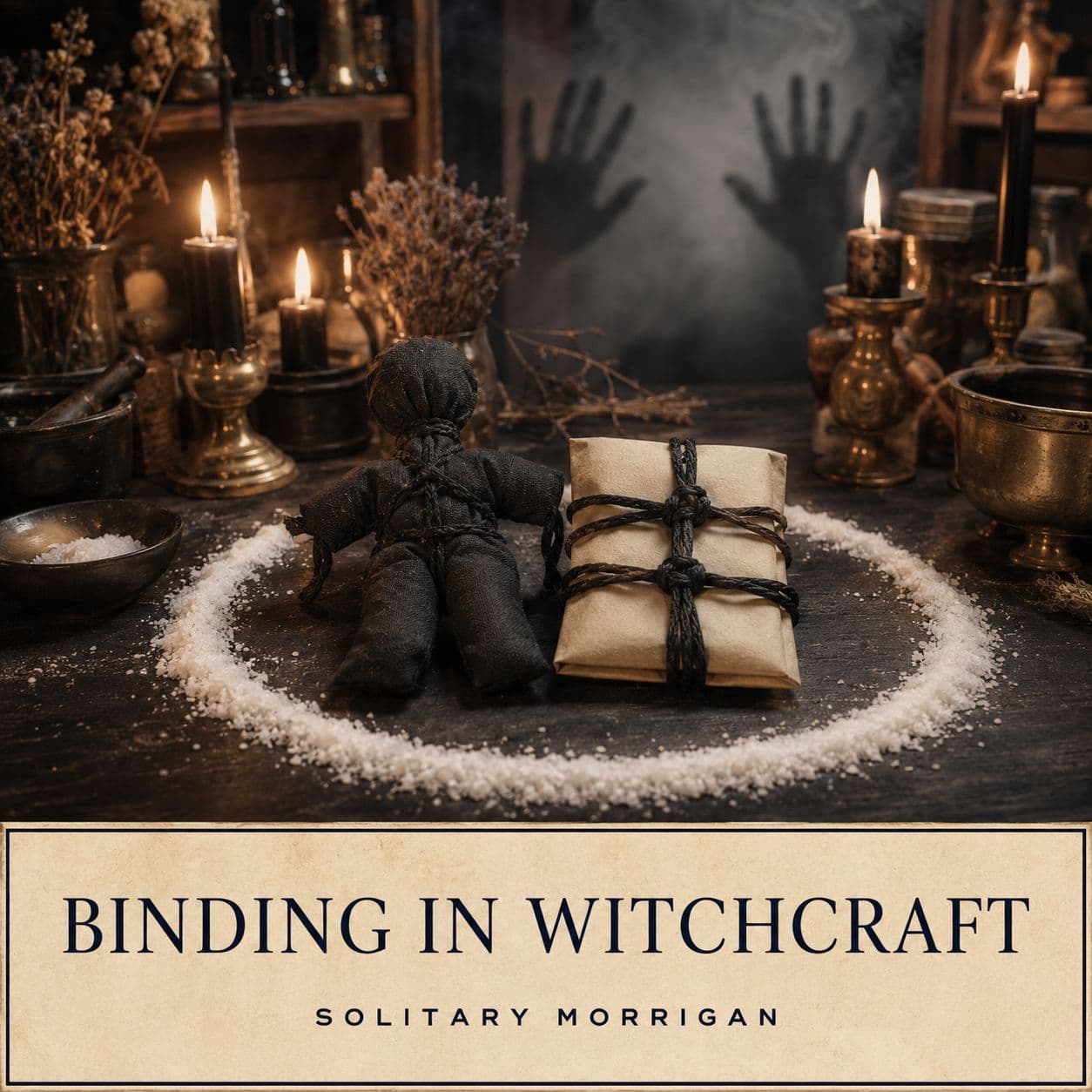
Binding is one of those words that causes an immediate reaction. Some people hear it and think of protection. Others imagine domination, punishment or somebody’s free will being tied up in black cord. As usual with witchcraft, the truth is not quite as tidy as either version.
I have always regarded binding as a practical form of restraint. You are not necessarily trying to destroy a person, drive them away or fill their life with misery. You are identifying the harmful part of their influence and stopping it from reaching you. That might mean silencing malicious gossip, preventing somebody from interfering in a relationship, restricting an abusive person’s access to you or containing spiritual energy that has become disruptive.
The word restraint matters. A good binding needs a clear target and a clearly defined limit. “Bind Sarah” is vague. Bind Sarah’s ability to spread lies about me is precise. The first attempts to tie down an entire person. The second deals with the behaviour causing the problem.
Personally, I think this is where many modern explanations go wrong. They describe binding as if it is automatically harmless because no curse has been spoken. It is still an act of magical control. Sometimes that control is justified and necessary. Sometimes it is exactly what allows somebody to reclaim their peace. But pretending it carries no force at all does not make the work kinder. It only makes the practitioner less honest about what they are doing.
What Does a Binding Spell Actually Do?
A binding spell restricts movement, action, influence or access. In magical terms, it creates a condition around the target. It might prevent a person from acting on harmful intentions, stop a situation from escalating or contain an influence so it can no longer spread.
The target does not always have to be another person. A practitioner may bind their own tendency to overspend, self sabotage or return to a damaging habit. A household binding might contain arguments that keep flaring up between relatives. An object can be wrapped and sealed when it appears to be carrying unpleasant energy. A curse or hostile working can be bound so that it is unable to continue feeding upon its intended victim.
What all of these workings share is the idea of limitation. The magic is not asking the unwanted thing to leave politely. It is giving it less room in which to operate.
This is also why the wording of a binding is so important. If the petition is broad, emotional or confused, the result can feel equally muddled. Binding “all communication” from somebody when what you actually want is to stop their abuse could also close down the practical conversation needed to resolve a shared financial or family matter. The intention should name the problem, not simply express anger at the person attached to it.
Binding Has a Much Older History Than Modern Witchcraft
Binding is not a recent invention and it was certainly not created by social media witches wrapping photographs in black thread. Some of the clearest historical examples come from the Greek and Roman worlds, where written binding spells were placed upon thin sheets of lead. These objects are usually called curse tablets, although that modern label can hide the variety of purposes they served.
The Greek term katadesmos carries the sense of binding down, while the Latin defixio is connected with fixing, fastening or transfixing. Names were written, folded, pierced and deposited in graves, wells, sanctuaries and other places thought suitable for carrying the request into the unseen world. Some were intended to hinder an opponent in court. Others targeted thieves, business rivals, performers, athletes or desired lovers.
A surviving Roman tablet in the British Museum, dated to around the third century, names a legal adversary. Finds from Roman Britain include tablets addressed to deities for the return of stolen property or punishment of a thief. These were not all soft defensive charms. They could demand silence, confusion, failure, compulsion or defeat.
That does not mean a modern cord binding is identical to an ancient lead tablet. It is better to say that the wish to restrict another person through magical means has an extremely long history. The materials, spirits, language and ritual setting changed from one place and century to another.
Knots have also carried magical meaning across many traditions. A knot physically demonstrates the act of fastening something in place. It can hold a blessing, secure a promise, trap an illness, impede sexuality, restrain an enemy or preserve power until the knot is released. That range is worth remembering. There is no single universal meaning of a knot. Its purpose comes from the ritual, the words spoken over it and the tradition in which it is used.
Binding, Banishing and Cursing Are Not the Same Thing
These three types of work are often thrown together, yet they do very different jobs.
Banishing removes. If somebody’s presence, influence or energy needs to leave your life entirely, banishing pushes it away and closes the route back. It is the magical equivalent of showing something the door.
Binding restricts. The person may remain in your workplace, family or wider life, but their ability to harm, interfere or manipulate is limited. This is useful when complete separation is impossible or when the problem is one specific behaviour rather than the person’s entire presence.
Cursing directs harm, suffering, loss or consequence towards a target. A curse may contain binding elements, particularly if it restricts a person’s luck, speech, movement or power. Equally, a binding can become punitive if it is designed to constrict every part of somebody’s life. The boundary between the two is not created by using black thread instead of a black candle. It lies in what the spell is actually intended to do.
There is also freezing magic, which overlaps with binding but has its own character. A freezer spell stops activity by placing the named influence into stillness. It is particularly good for cooling gossip, arguments, unwanted attention and situations that need to lose momentum. A cord binding feels more like fastening or restraining. A freezer spell feels like suspension. Similar intention, different magical language.
When Binding Is the Right Kind of Work
One thing I have noticed is that people often consider a binding after they have spent far too long trying to reason with somebody who has no intention of behaving reasonably. They have explained themselves, set boundaries, blocked numbers, avoided arguments and still find the same person pressing against their life.
That is exactly the sort of situation in which restraint makes sense. A binding can be used against persistent gossip, harassment, manipulation, intimidation, unwanted interference and deliberate attempts to destabilise your home or relationship. It is also useful when the target holds a position you cannot simply escape, such as a difficult colleague, neighbour or relative.
Protection binding works slightly differently. Instead of focusing entirely upon what the other person cannot do, it establishes what they cannot do to you. Their malice cannot cross your threshold. Their words cannot damage your reputation. Their spiritual attacks cannot attach themselves to your energy. This approach places your boundary at the centre of the spell.
Self binding can be valuable as well, although it needs careful wording. It can help restrict a particular habit, reaction or compulsion while other practical changes are being made. I would never bind somebody’s entire appetite, voice, sexuality or emotional life in the hope of solving one problem. The working should limit the harmful action without treating the whole self as the enemy.
Binding can also be used to contain spiritual activity. If an object feels troubled, it may be wrapped, tied, boxed or sealed while a decision is made about cleansing or disposal. If hostile magic is suspected, a practitioner may bind the working itself before removing it. The aim is to stop the influence spreading while more complete work is carried out.
Choosing the Correct Target
Before gathering candles or cord, decide precisely what you are restraining. This sounds obvious, but it is the step most likely to be rushed when somebody is frightened or angry.
Ask what is actually causing the damage. Is it the person’s speech, access, influence, temper, dishonesty or spiritual interference? Do you want them silent, distant, unable to act, unable to reach you or simply uninterested in continuing? Those are different outcomes.
A photograph, name paper or personal concern creates the link to the individual. The petition tells the spell which part of their conduct is being bound. Without that distinction, the working can become a knot of emotion rather than a controlled act of magic.
I prefer petitions that describe the limit plainly. For example: “Your lies about me are bound. They find no willing ear and cause no damage.” That is far more useful than filling a page with every insult the person has ever caused. Anger can raise power, but it should not be allowed to write the instructions.
Traditional Symbols Used in Binding Magic
Cord and thread are obvious choices because the physical action mirrors the magical intention. Black is popular for restriction, containment and the removal of harmful influence, although it is not compulsory. White cord may be chosen for a protective binding, red for a volatile relationship or brown for a problem involving the home and practical stability. The colour helps focus the practitioner. It does not replace the work.
A written petition gives the spell language and direction. It can be folded away from the practitioner if the aim is to reduce somebody’s influence, then wrapped tightly with cord. Knots may be tied one at a time while each part of the restriction is spoken aloud.
Figures and poppets create a bodily representation of the target. The hands may be bound to stop harmful action, the mouth to stop lies or the feet to prevent pursuit. This symbolism can be extremely direct, which is why care with the petition matters. If the purpose is to stop one behaviour, there is no need to wrap the entire figure until it looks like a parcel nobody ordered.
Containers provide another form of restraint. A name, photograph or representation can be placed inside a jar or box, then sealed and kept somewhere dark and undisturbed. Mirrors may be used to reflect the person’s intentions back towards them. Salt can define a boundary, while protective herbs or oils reinforce the purpose of the working.
Candles can bring movement and authority to the ritual. A black candle may consume the target’s harmful access while a white or blue candle protects peace around the practitioner. Some bindings rely upon one candle wrapped with cord. Others use no flame at all. The most impressive altar in the world cannot rescue a spell whose intention has never been properly decided.
A Simple Protective Cord Binding
For a straightforward protective binding, begin with a small piece of paper, black cord, a candle and a fireproof dish. Write the person’s full name if it is known. Beneath it, state the behaviour being restrained and the boundary being established.
Fold the paper away from yourself. Wrap the cord around it slowly, keeping your attention upon the unwanted influence becoming smaller, weaker and less able to reach you. Tie a knot and speak the first restriction. Continue wrapping and knotting until the paper is secure.
The words do not need to rhyme. Speak plainly. Name what is stopped and what remains protected. You might say that the target’s lies are bound, their interference cannot enter your home and their harmful intention has no path towards you.
Place the bundle beside the candle rather than close enough to burn. Let the flame strengthen your authority over your own space. When the ritual feels complete, extinguish the candle safely and store the bundle somewhere dark where it will not be disturbed.
The object is not rubbish left over after the spell. It is part of the working. Keep it if the restriction is meant to remain active. If circumstances change, you can return to it and release the knots deliberately.
Why Disposal Matters
The original article suggests burying the object or throwing it into running water. I would not recommend either as a standard rule. Water disposal has a long symbolic appeal, but rivers are not bins. Wax, thread, photographs, pins, salt and jars do not belong in them. Burying synthetic materials creates the same problem in the soil.
Disposal should match the spell. A continuing binding is usually kept secure, hidden and undisturbed. A temporary binding can be dismantled when it has served its purpose. Paper and natural cord may be burned safely where appropriate, while glass, metal and synthetic material should be cleaned or disposed of responsibly.
The magical act of release comes from consciously ending the working. It does not depend upon leaving ritual debris in a woodland or pushing a jar into a stream and making it somebody else’s problem.
Can a Binding Spell Be Broken?
Yes. No binding should be treated as automatically permanent or impossible to undo. It can weaken because the practitioner stops feeding it, because the target resists, because circumstances alter or because another working disrupts it.
The original caster can release a cord binding by untying or cutting the knots while withdrawing the command. A sealed petition can be opened, cleansed and destroyed. A frozen spell can be thawed. If the object has been kept, reversing the work is usually much more controlled.
Some bindings are intended to last only until a particular condition is met. This can be written into the petition from the beginning: until the harassment ends, until the legal matter is settled or until the target loses interest in interfering. A clear release condition prevents the working from continuing without purpose.
If you believe somebody has bound you, begin with cleansing and divination before assuming every delay or blocked opportunity is magical. A genuine binding can be challenged through uncrossing, cord cutting, spiritual cleansing and a deliberate counter-working. The essential act is to reject the imposed limit and restore your own authority.
Binding Is About Control, So Be Honest About It
There is no need to pretend that binding never touches free will. If you magically restrain another person from speaking, acting or approaching, you are attempting to influence their choices. The question is not whether control exists. It is what you are controlling, why you are doing it and how far the restriction reaches.
My own view is straightforward. If somebody is causing harm and ordinary boundaries have failed, I do not see virtue in remaining defenceless merely so the other person’s freedom remains completely untouched. They have already used that freedom to interfere with yours. A precise binding can restore the balance without destroying every other part of their life.
What I would question is using binding for every irritation, disagreement or bruised ego. Restraining somebody because they will not love you, agree with you or do what you want is a different kind of work from stopping harassment. Both may be called binding, but they should not be described as if they carry the same intention.
Fear of a spell “backfiring” is often used to avoid this conversation. Magic is not a machine that automatically punishes anybody who uses it from anger. The more practical danger is poor construction. A vague target, contradictory petition or uncontrolled emotional state can produce confused work. Precision matters more than pretending to feel saintly.
Taking Back the Space That Belongs to You
Binding is powerful because it gives form to a boundary. The cord tightens, the knot closes, the box shuts and the unwanted influence is told that it can come no further. Those physical actions make an invisible decision tangible.
Used well, binding does not have to consume your attention. Its purpose is to stop the other person or influence from continuing to occupy your thoughts, home and energy. Once the work is secured, your focus should return to your own life.
That is the part of binding I value most. It is not endless magical warfare and it is not punishment dressed up as protection. It is the moment when you stop asking a harmful influence to behave differently and establish a limit it cannot simply ignore.
A properly constructed binding names the harm, restrains it and protects what lies beyond it. Sometimes transformation begins with attracting something new. Sometimes it begins with finally fastening the door against what should never have been allowed to follow you this far.
Sources Consulted
British Museum, Roman curse tablet naming a legal adversary, collection number 1891,0418.1.
Esther Eidinow, “Binding Spells on Tablets and Papyri”, in Guide to the Study of Ancient Magic.
National Archaeological Museum, Athens, “I bind down, bury deeply and make disappear from humanity”.
British Library, “Love Spells in the Greek Magical Papyri”.