
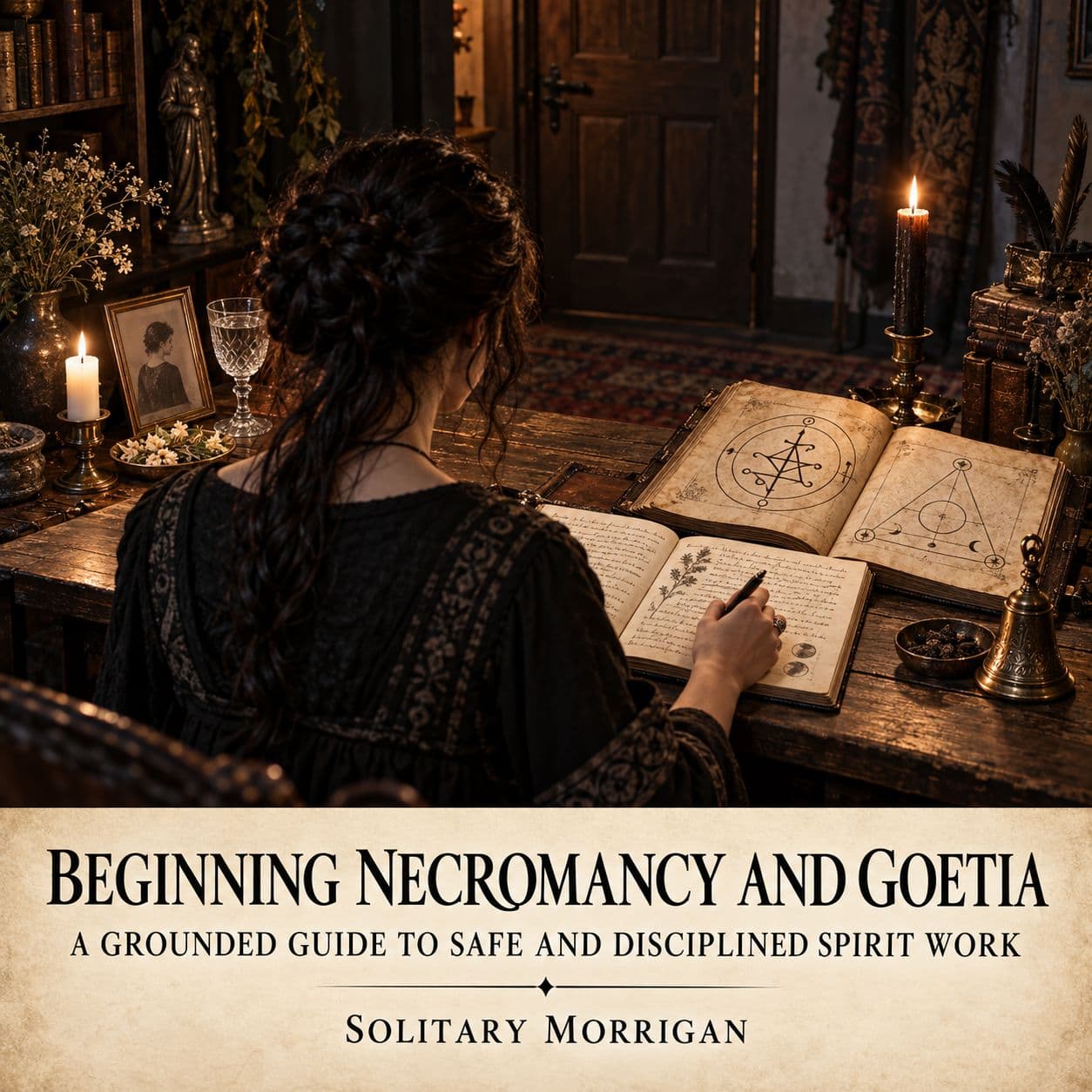
Necromancy and Goetia are often pushed together beneath the rather convenient label of “dark spirit work”. Spend any time studying them properly, however, and you soon discover that they are not two versions of the same practice.
Necromancy concerns communication with the dead. Depending upon the period and tradition, that might mean seeking knowledge from a deceased person, honouring ancestors, consulting spirits through divination or working with the dead within a wider magical operation.
Goetia usually refers to the first book of the Lemegeton, better known as the Lesser Key of Solomon. It presents seventy-two spirits alongside seals, ranks, offices and a ritual framework for calling them. The surviving compilation is generally dated to the seventeenth century, although parts of it draw upon older material, including Johann Weyer’s sixteenth-century spirit catalogue. esotericarchives.com
Both paths involve spirit contact, but they developed differently and should be studied separately before anyone attempts to combine them.
I understand the attraction. These practices promise contact with something beyond ordinary experience. They offer knowledge, insight and an encounter with powers that cannot be reduced to another pleasant candle spell. Yet that fascination can encourage beginners to rush straight towards the most dramatic ritual they can find.
That is rarely a good beginning.
Safe spirit work is not created by buying an impressive collection of tools or reciting a warning over a candle. It comes from preparation, reliable study, firm boundaries and the ability to remain calm when an experience does not unfold as expected.
Decide Which Path You Actually Want to Study
Before tracing a seal or attempting to call the dead, ask what you are genuinely looking for.
Do you want to honour and communicate with your ancestors? Are you trying to reach one particular deceased person? Are you interested in historical necromancy? Or are you drawn to a named Goetic spirit because its traditional office relates to something you wish to learn or change?
These are different intentions and require different preparation.
Someone beginning ancestral work does not need to construct a full Solomonic temple. Equally, someone studying the Ars Goetia should not assume that general mediumship exercises have taught them how to use a grimoire system.
Choose one direction first. Learn its language, structure and expectations before adding another. There is no prize for attempting three systems at once.
Understand What Necromancy Has Meant
Modern people often hear “necromancy” and imagine somebody standing in a graveyard commanding corpses to rise. That image owes far more to fiction than to the full history of the practice.
The word originally referred to divination through the dead. In ancient practice, the deceased might be consulted for knowledge that living people could not obtain. Later medieval sources used related terms much more broadly, sometimes applying them to learned ritual magic involving demons, angels or other spirits rather than the human dead alone. resolve.cambridge.org
This means there is no single ritual that represents all necromancy. It has included grave rites, dream incubation, offerings, divination, funerary magic, ancestor work and elaborate ceremonial operations.
A beginner does not need to start in a cemetery at midnight. A quiet remembrance practice at home is often a far better foundation. Place a photograph or written name on a clean surface, offer fresh water and light a candle. Speak respectfully, sit quietly and record anything you experience.
Begin with people you knew, trusted or can place within your family line. Calling unknown spirits simply because they are dead adds unnecessary uncertainty. Death does not automatically make a person wise, honest or interested in helping you.
Understand What the Goetia Actually Contains
The Ars Goetia is not merely a list of demons and attractive seals. It belongs to a ceremonial system with prayers, conjurations, divine names, ritual boundaries and formal methods of dismissal.
The famous Triangle of Art appears within that structure as a designated place in which the spirit is instructed to appear. The operator is traditionally protected within a circle and works through divine authority. This is quite different from the modern idea of casually inviting a spirit into the room for conversation. esotericarchives.com
You do not have to practise historical Solomonic magic exactly as written. Many contemporary demonolaters and independent occultists approach these spirits through meditation, offerings and less confrontational rites. That is a valid modern choice, but it should be described honestly.
Enns, for example, are widely used in modern demonolatry but do not appear in the original Goetic conjurations. Calling an enn “the ancient invocation of the spirit” quietly rewrites history. If you use modern methods, understand where they come from and do not assume that every popular correspondence belongs to the older grimoire.
There is also no universally accepted list of colours, planets, herbs and offerings for every Goetic spirit. Some associations are drawn from later occult systems, while others have been created by individual practitioners. The seal and office found in the grimoire are historical material. A favourite incense suggested on social media may not be.
Learn to Observe Before You Attempt Contact
The most valuable skill in spirit work is not summoning. It is discernment.
Can you sit quietly for twenty minutes without chasing every passing thought? Can you tell the difference between intuition, expectation and anxiety? Can you record an experience without immediately declaring it supernatural?
Spend time developing meditation, dream recall and divination before attempting formal contact. Tarot, scrying or another familiar method can help establish a baseline for how your mind processes symbols.
This matters because anticipation can be powerful. If you perform a dramatic ritual expecting a room to turn cold, every draught suddenly feels meaningful. If you expect a spirit to communicate through dreams, an ordinary nightmare can become a warning from beyond.
Not every flickering candle is an answer. Not every headache is spiritual resistance. Not every animal seen after a ritual is a familiar or messenger.
Real discernment includes the willingness to say, “I do not know what that was.”
Build a Stable Foundation
Spirit work should be approached when you are rested, sober and capable of making clear decisions. Alcohol and recreational drugs do not make you more spiritually open in a useful way. They make perception less reliable and boundaries harder to maintain.
Sleep deprivation creates the same problem. Staying awake until three in the morning because an online ritual insists that this is the only powerful hour can leave you exhausted, suggestible and frightened by completely ordinary sounds.
Before beginning, make certain that:
- You have slept and eaten properly.
- You are not intoxicated.
- Your emotional state is reasonably steady.
- Nobody is likely to interrupt you.
- Candles and incense can be used safely.
- You know exactly how the ritual will end.
- You have a telephone and ordinary lighting nearby if needed.
This is not glamorous advice, but it prevents far more trouble than carrying a pocketful of supposedly protective crystals while ignoring your physical surroundings.
If spirit work begins to worsen persistent anxiety, paranoia, sleeplessness or frightening sensory experiences, pause the practice. Spiritual interpretation and practical support can exist together. Seeking help from a doctor or mental health professional does not betray your path.
Cleansing and Protection
Cleansing creates a deliberate change between ordinary space and ritual space. It helps focus the mind and reinforces the boundary around the work.
You might clean the room physically, wash your hands, change your clothes and use incense, sound or blessed water. Historical ritual magic frequently treated purity and preparation as serious requirements rather than decorative extras. Hyssop, for example, appears in medieval magical material as a purifying plant used with consecrated liquid. cambridge.org
Choose a protection method that belongs to your practice and that you understand. This might involve prayer, a ritual circle, protective spirits, divine names, wards or a firmly visualised boundary.
Do not collect protective methods from six unrelated traditions and use them all in panic. Confidence comes from practising one method until you can perform it steadily.
Protection also includes deciding what is permitted. You can state that only the intended spirit may approach, that communication must remain within the ritual and that nothing may attach itself to you, another person, an animal or the home.
Whether you understand those words metaphysically or psychologically, they establish the limits of the operation.
Work with One Spirit at a Time
Beginners sometimes call several spirits in one ritual because they believe more entities will produce more power. Usually, it produces confusion.
If you receive an impression, voice, dream or change in atmosphere, how will you know which spirit it belongs to? If the operation becomes uncomfortable, which contact are you attempting to close?
Choose one named spirit or deceased person. Research them properly. Decide upon one clear purpose and a small number of questions.
Avoid vague requests such as “Show me everything I need to know.” A focused question produces something you can evaluate. An unlimited request gives your imagination an unlimited field in which to wander.
For early workings, set a reasonable duration. Twenty to forty minutes is sufficient. Remaining in ritual for hours does not prove commitment, especially when concentration has already collapsed.
Respect Does Not Mean Surrendering Your Boundaries
Courtesy matters, but spirit work should not be confused with submission.
In work with the dead, a glass of water, candle or familiar food may be given as an act of remembrance. If you did not know the deceased, do not invent an intimate relationship that never existed.
In contemporary Goetic practice, offerings may be given as part of an agreement or devotional relationship. In traditional Solomonic practice, the tone and method are markedly different. Decide which approach you are following before the ritual rather than changing position halfway through it.
Never promise an offering, service or ongoing devotion simply because you feel overwhelmed in the moment. If you make an agreement, write down its exact terms.
Do not accept every apparent message as an instruction. A spirit claiming authority over you does not automatically possess it. A message encouraging dangerous behaviour, isolation, financial recklessness or harm should not be obeyed merely because it arrived during ritual.
Respect and discernment belong together.
Be Careful with Graveyards and Human Remains
Necromancy does not require stealing from graves.
Graveyards are real places of grief, remembrance and law. They are not free supply shops for dirt, bones, flowers, nails or pieces of stone. If you visit one, behave as you would want a stranger to behave at the grave of somebody you love.
You do not need human bones or a genuine coffin nail to establish contact with the dead. Photographs, written names, inherited objects, memorial cards, soil from your own land and properly acquired ritual tools are enough.
If local custom permits graveyard offerings, leave something appropriate and harmless. Do not bury objects without permission, damage memorials or leave glass, wax, salt, plastic or anything that creates work for the people maintaining the grounds.
Timing Can Support the Work, but It Is Not Everything
You will frequently see claims that necromancy must be performed on Saturday, during a waning Moon or between midnight and three in the morning. These timings may belong to particular systems, but they are not universal laws.
Planetary timing can be useful when it has a clear relationship to the operation. Saturn may be chosen for ancestors, endings or the grave. Mercury may be chosen for communication, divination and the transmission of messages. Lunar timing may be used where dreams and spirit sensitivity are central.
Goetic timing is equally complicated. Historical manuscripts, later ceremonial systems and modern practitioners do not always agree.
Choose one system and learn why it assigns a particular time. The explanation matters more than copying a correspondence chart without context.
Practical timing matters as well. A calm evening when you are rested and undisturbed is better than a supposedly perfect planetary hour when you are exhausted and watching the clock.
Keep a Detailed Record
Write down the date, time, purpose, preparation and method before beginning. Afterwards, record what actually happened without polishing it into a dramatic story.
Include:
- Your physical and emotional state.
- The spirit or deceased person addressed.
- The ritual method and words used.
- Offerings given or promises made.
- Sensations, images, sounds or thoughts.
- Divination performed before or afterwards.
- Dreams and unusual events during the following days.
- Ordinary explanations that should also be considered.
The final point is important. If a candle extinguished, check the wick and airflow. If something moved, consider vibration, pets and open windows. Eliminating ordinary causes does not weaken genuine spiritual practice. It makes your conclusions more reliable.
Wait before interpreting the entire experience. A pattern repeated over several workings is more useful than one impressive coincidence.
Close Every Working Deliberately
A ritual does not end because you feel tired or because the candle has gone out.
Thank the deceased or spirit for any appropriate communication. State clearly that the working is complete. In a Goetic operation, use the licence to depart or the closing formula belonging to your chosen system. If you opened quarters, called protective powers or established a circle, release them in the correct order.
Then extinguish flames safely, remove offerings at the appropriate time and return the room to ordinary use. Wash your hands, eat something, drink water and write your record.
You may also ring a bell, open a window or cleanse the room. The purpose is not to behave as though every spirit is contaminating. It is to mark a definite transition out of ritual awareness.
Do not immediately perform another divination because you disliked the first answer. Repeatedly asking the same question usually produces anxiety and contradiction rather than clarity.
Know When to Stop
Stop if you feel physically unwell, overwhelmed or unable to maintain the structure of the ritual. You do not need to prove bravery by continuing.
Pause the wider practice if you begin losing sleep, neglecting ordinary responsibilities or interpreting every inconvenience as spiritual attack. A good magical practice should deepen your awareness of life, not make ordinary life impossible.
You are also allowed to decide that a particular spirit or method does not suit you. Curiosity is not a lifelong contract.
Some of the strongest practitioners I know are not the ones who claim constant visions and daily manifestations. They are the ones capable of ending an operation calmly, admitting uncertainty and waiting until they are properly prepared before trying again.
A Strong Beginning Is Better Than a Dramatic One
Necromancy and Goetia both reward patience, but neither needs to begin with spectacle.
Study the history. Choose one system. Develop your concentration. Learn a reliable method of protection and practise closing it before adding spirit contact. Begin with a clear, limited purpose and record what happens honestly.
The aim is not to become fearless. Fearlessness is often little more than poor judgement dressed attractively. The aim is to become steady enough that curiosity does not overrule common sense.
There will always be another night, another planetary hour and another opportunity to perform the ritual. Waiting until you are genuinely ready is not weakness. It is one of the first signs that you may eventually become competent.