
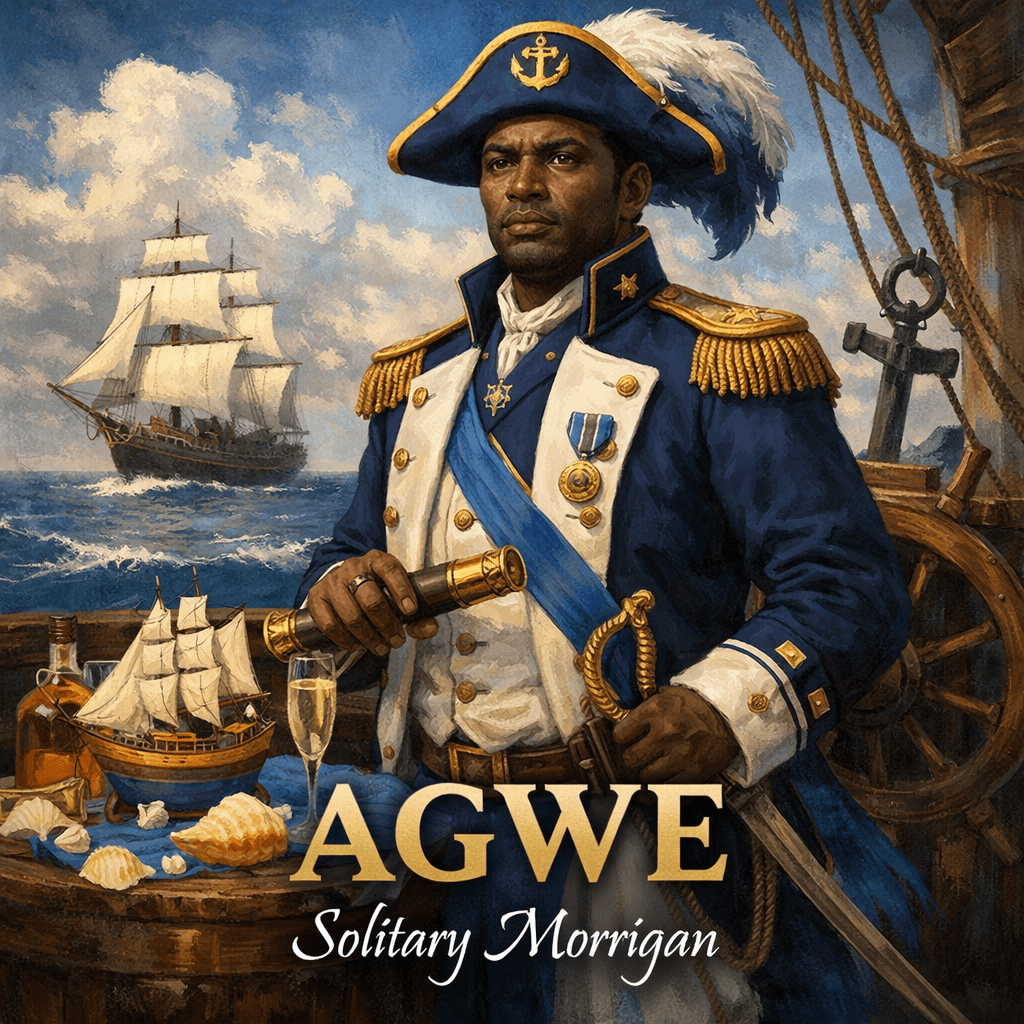
There is something about the sea that humbles you instantly. You can stand at the shoreline feeling strong and certain, only to watch a storm roll in and realise how small you really are. The ocean gives life, carries trade, feeds nations and swallows ships without apology. It is vast, intelligent and deeply spiritual. Within Haitian Vodou, the spirit who governs these waters is Agwe.
Agwe is the lwa of the sea, of sailors, fishermen, naval power and maritime authority. He is not simply a god of water in a general sense. He is the commander of the ocean itself, the admiral who rules its tides, its ships and the spirits that move beneath the surface. For anyone drawn to sea magic, oceanic spirits or the mysteries of deep water, understanding Agwe opens the door to a powerful current within Vodou cosmology.
This article explores who Agwe is, how he is honoured in Haitian Vodou, his symbols and offerings, and the deeper spiritual meaning behind his watery domain.
Who Is Agwe in Haitian Vodou?
Agwe, sometimes referred to as Agwe Tawoyo or Agwe Woyo, is one of the principal lwa of Haitian Vodou. He is associated specifically with the sea rather than rivers or fresh water. Those domains belong to other spirits within the Vodou pantheon.
In Vodou belief, the lwa are intermediaries between Bondye, the distant creator, and humanity. They are not gods in the Western sense. They are powerful spirits who govern aspects of existence and who can be petitioned, honoured and served. Agwe governs everything connected to the ocean. This includes sailors, fishermen, ships, naval forces, marine life and the vast spiritual symbolism of deep water.
He is often described as an admiral. Devotees may visualise him dressed in naval uniform, complete with sword, epaulettes and ceremonial hat. He represents discipline, order and authority over the unpredictable sea.
The Sea as Sacred Space in Vodou
To understand Agwe properly, you need to appreciate the spiritual importance of water within Vodou. Water is not simply an element. It is a gateway. It is linked to ancestral memory, especially considering the history of the transatlantic slave trade, during which countless African souls crossed the ocean under horrific conditions.
For many practitioners, the sea holds both trauma and transformation. It is a place of passage. It is where spirits travel. It is where offerings are carried from the human world to the spiritual realm.
Agwe rules this immense, living body of water. He commands the tides that connect continents and carry spirits. In that sense, he is a guardian of movement, travel and transition.
Agwe’s Personality and Energy
Agwe is typically described as dignified, composed and proud. He carries himself like a military officer. He appreciates respect, formality and proper conduct.
Unlike some lwa who are fiery, chaotic or highly sensual, Agwe’s energy is often cooler and more contained. That does not make him gentle. The sea can be calm one moment and devastating the next. His temperament reflects that duality. He can bless a voyage or overturn a vessel. He can provide abundance through fishing or withhold it.
Those who work with Agwe often say that he responds well to sincerity and clear intention. He values loyalty and respect. Approaching him casually or disrespectfully would not be wise.
Symbols and Sacred Objects of Agwe
Agwe’s symbols are strongly maritime. These often include:
Ships and model boats
Anchors
Oars
Naval flags
Sea shells
Swords
Blue and white cloth
The colours most commonly associated with Agwe are blue and white, reflecting the ocean and sea foam. In ritual settings, altars dedicated to him may be decorated with nautical imagery. Small boats are especially important and are often used in offerings.
His veve, the sacred ritual symbol drawn to call him, typically incorporates imagery that suggests boats or marine structure. As with all veves in Vodou, it is drawn with intention and ritual care.
Offerings to Agwe
Offerings to Agwe are traditionally taken to the sea itself. This is one of the most distinctive aspects of his service. Rather than leaving offerings on a land altar, devotees often carry them out onto the water.
It is common to place offerings inside a small wooden boat or crafted vessel. This may include food, drink, candles and symbolic items. The boat is then floated out to sea.
Typical offerings may include:
Champagne
Rum
White foods such as rice
Cooked fish
Sweet offerings
Naval decorations or miniature boats
If the offering boat floats away successfully, it is considered a sign that Agwe has accepted the offering. If it returns to shore, this may indicate that something was amiss or that further work is needed.
There is something incredibly powerful about this act. You are not simply lighting a candle in a room. You are standing before the ocean and releasing your petition into its depths.
Agwe and Possession in Vodou Ceremony
During Vodou ceremonies, lwa may mount or possess devotees. When Agwe mounts someone, the behaviour often reflects his naval authority.
The possessed individual may stand upright, adopt formal posture and gesture as though commanding a crew. They may salute, give orders or mimic the motion of steering a ship. Water may be sprinkled or requested.
In some ceremonies, when Agwe arrives, a basin of water may be placed before him. He may symbolically wash his hands or interact with the water to affirm his presence.
These manifestations reinforce his identity as commander of the sea. The ritual space becomes a symbolic ship under his authority.
The Relationship Between Agwe and Other Water Spirits
It is important not to confuse Agwe with other water lwa. In Vodou, different spirits govern different aspects of water.
La Sirene, for example, is associated with the beauty and enchantment of the sea. She is linked to mermaid imagery and feminine mystery. While both Agwe and La Sirene are connected to oceanic forces, their personalities and domains differ.
Simbi spirits are generally connected to rivers and fresh water, as well as magic and knowledge. They are not interchangeable with Agwe.
Understanding these distinctions is crucial for respectful spiritual practice. Each lwa has their own temperament, offerings and areas of influence.
Agwe and Protection at Sea
For those who travel by sea or whose livelihoods depend on fishing or maritime trade, Agwe is invoked for protection. He governs safe passage, fair winds and successful voyages.
Historically, in Haiti and other parts of the Caribbean, fishermen and sailors would call upon Agwe before setting out. The sea provides sustenance but also danger. Appeasing its ruler is both spiritual devotion and practical wisdom within Vodou belief.
Even today, some devotees may pray to Agwe before cruises, overseas travel or significant journeys involving water.
Agwe in the Context of Haitian History
The sea is inseparable from Haitian history. It carried enslaved Africans to the island of Hispaniola. It connected Haiti to colonial powers and global trade routes. It also served as a route for revolution and resistance.
Agwe’s presence within Vodou reflects this complex relationship with the ocean. He is not simply a picturesque sea deity. He stands at the crossroads of survival, trauma, migration and resilience.
For many practitioners, honouring Agwe is also an act of remembering ancestral endurance.
Working With Agwe in Modern Practice
For those outside Haiti who feel drawn to Agwe, caution and respect are essential. Haitian Vodou is a living religion with initiatory structures and lineage. It is not simply a collection of spirits to pick and choose from.
If someone wishes to honour Agwe respectfully, they should begin with research and cultural understanding. Learning about Haitian history, Vodou cosmology and the role of the lwa is fundamental.
Simple gestures such as offering a glass of water by the sea with sincere prayer may be appropriate for those who are not initiated. Attempting complex rituals without guidance would not be advisable.
Agwe responds to authenticity. Standing by the ocean, speaking honestly, acknowledging his authority and expressing gratitude can be a meaningful start.
The Deeper Spiritual Meaning of Agwe
Beyond his literal domain, Agwe represents depth, emotional vastness and the unconscious. The ocean is often used symbolically to represent what lies beneath the surface of awareness.
Working with Agwe can mirror inner work. Just as the sea contains hidden currents and unseen creatures, the human psyche contains hidden memories and emotional depths.
He teaches respect for forces greater than oneself. He reminds us that control is often an illusion. We can navigate, steer and prepare, but we cannot command the tide.
There is also something profoundly cleansing about the sea. Standing before it strips away ego. Agwe’s energy can feel like that. Direct. Bracing. Clarifying.
Agwe in Art and Popular Culture
Agwe has occasionally appeared in literature and artistic depictions of Vodou, though often misunderstood. Popular media has a long history of distorting Vodou imagery.
It is important to separate sensationalism from authentic practice. Agwe is not a caricature or horror trope. He is a respected and honoured lwa within a complex spiritual system.
When represented accurately, he appears as a naval commander of dignity and authority, surrounded by maritime symbolism.
Honouring Agwe With Respect
If you ever find yourself drawn to the sea at night, listening to waves break under moonlight, you may sense why so many traditions treat the ocean as sacred.
To honour Agwe is to honour the sea itself. It is to recognise that water carries memory, spirit and power. It is to stand humbly before something ancient and immense.
For practitioners of Vodou, Agwe is not abstract. He is present. He can mount a devotee, accept an offering and guide a ship home.
For those observing from outside the tradition, learning about Agwe offers insight into the spiritual richness of Haitian Vodou and the deep symbolic language of water.
Conclusion
Agwe is the lwa of the sea, sailors and maritime authority within Haitian Vodou. He commands respect, embodies discipline and governs one of the most powerful natural forces on earth. His offerings are given directly to the ocean. His symbols reflect naval command and oceanic strength. His energy carries both calm and storm.
Understanding Agwe means understanding the sacred role of water in Vodou. It means recognising the ocean not just as scenery, but as living spiritual territory.
Whether approached through formal service within Vodou or through respectful study, Agwe stands as a reminder of depth, power and humility. The sea does not bend to us. We learn to navigate it. In that lesson alone, there is profound spiritual wisdom.