
Say the word Abracadabra now and most people picture a man in a dinner jacket producing a rabbit from somewhere no rabbit ought reasonably to fit. It has become shorthand for pretend magic, children’s parties and the theatrical moment when the impossible is meant to happen.
That is rather unfair on the word itself.
Long before stage magicians adopted it, Abracadabra was being written as a protective healing charm. Not spoken over a silk handkerchief, but carefully inscribed, folded, bound and worn against the body by somebody frightened of a recurring fever. Its earliest surviving use is practical, physical and quite serious. The word was expected to remove something dangerous by making it disappear one letter at a time.
Personally, I think that makes Abracadabra far more interesting than the modern claim that it simply means “I create as I speak”. That translation sounds lovely and fits modern manifestation perfectly, which is probably why it has spread so widely. The trouble is that nobody has proved it. The true origin of the word remains uncertain.
What we do know is how the old charm was used, and that gives us a wonderfully clear piece of magic to work with today.
The First Surviving Abracadabra Charm
The earliest known written appearance of Abracadabra is found in a Latin medical poem generally called the Liber Medicinalis, or De Medicina Praecepta, attributed to Quintus Serenus Sammonicus. The author probably lived around the late second or early third century, although the details of his life and the dating of the work aren’t quite as tidy as popular summaries make them sound.
The text combines remedies, plants, medical advice and magical procedures in a way that may look strange to us now, but wouldn’t have seemed absurd in the Roman world. Medicine, religion and magic didn’t live in perfectly separate boxes. A person might use a herb, wear an amulet, pray to a god and consult a physician without feeling they had contradicted themselves at all.
Serenus gives Abracadabra as a remedy for a dangerous recurrent fever, often identified by modern writers with malaria. More precisely, the text refers to a semitertian fever. Calling it malaria is understandable, but we can’t diagnose every ancient fever from a short description nearly two thousand years later.
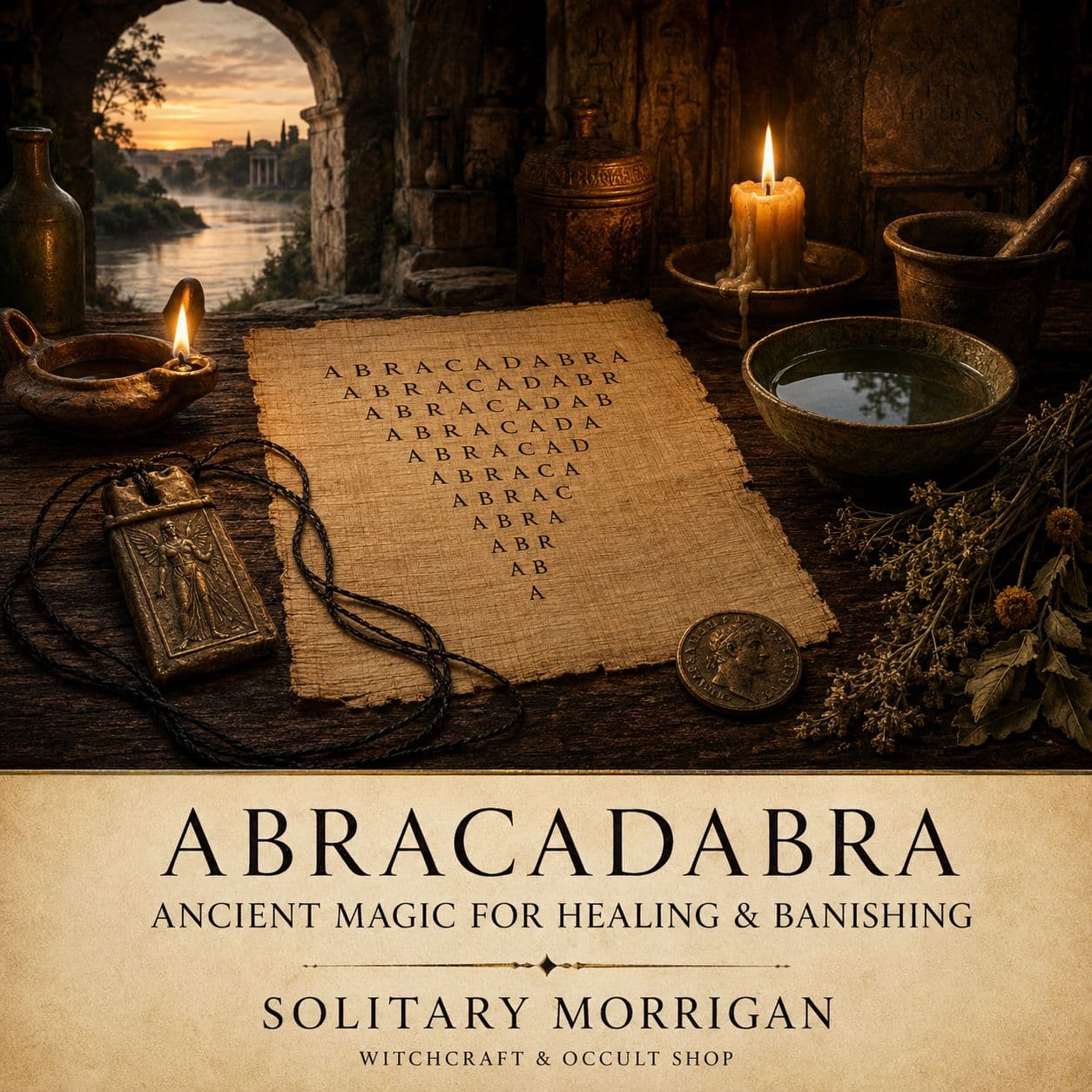
The instruction was to write the complete word and repeat it beneath itself, removing a letter each time until only one remained:
ABRACADABRA ABRACADABR ABRACADAB ABRACADA ABRACAD ABRACA ABRAC ABRA ABR AB A
The writing was then made into an amulet and worn around the neck. It wasn’t meant to remain there forever. After nine days, the wearer was instructed to remove it and throw it backwards over the shoulder into a river flowing east.
You can see the magical reasoning without needing Serenus to explain every part of it. The word loses its body line by line, and the fever is expected to weaken with it. The charm is worn close to the person while it draws away the condition, then it is removed and given to running water, which carries the last of it away. Throwing it backwards means the wearer doesn’t watch it go and, symbolically, doesn’t invite it to follow.
That isn’t vague manifestation language. It is a complete piece of sympathetic magic.
Why the Diminishing Triangle Matters
People often call the Abracadabra arrangement a triangle, although visually it can also look like a tapering wedge or the stepped edge of something being gradually cut away. Whatever name you give the shape, the action is one of reduction.
Every line is almost the same, but not quite. One letter has gone. Then another. Then another. The problem isn’t attacked in a single dramatic blow. It is denied the ability to remain whole.
I’ve always found this sort of magic extremely effective because the written action and the desired result are doing the same thing. If I’m reducing an influence, I want a spell that reduces. If I’m ending interference, I want to see it becoming smaller. If I’m trying to break a habit, weaken a rumour or take the heat out of a conflict, the disappearing word gives the mind and the magic a very clear path to follow.
It belongs to the same broad family of magical thinking as allowing a candle to burn down, untying a series of knots, washing writing from a surface or letting water carry something away. The physical process tells the energy what to do.
One thing I’ve noticed over the years is that people sometimes make spellwork needlessly complicated because they think more ingredients must mean more power. Abracadabra rather ruins that argument. Here we have one word, a writing surface, a thread and a deliberate disposal. It survived because the structure itself is powerful.
Does Abracadabra Mean “I Create as I Speak”?
This is probably the best-known claim about the word. You’ll see it traced to an Aramaic expression written in several different ways, usually avra kehdabra or avrah kadabra, and translated as “I create as I speak”, “I create according to the word” or something similar.
It is a beautiful idea. It also fits one of the central principles of magical practice: speech doesn’t merely describe intention, it gives intention shape and sends it out. A blessing, curse, prayer, conjuration or oath changes the atmosphere because words spoken with authority are acts in themselves.
But a satisfying explanation isn’t automatically a historical one. The Oxford English Dictionary treats the origin of Abracadabra as unknown and notes that the proposed derivations lack supporting documentation. Linguists have also challenged the popular Aramaic reconstruction. So I wouldn’t write Abracadabra means I create as I speak as though somebody had found a neat ancient inscription confirming it. They haven’t.
Other theories connect the word with Hebrew phrases of blessing, with Greek letter patterns, or with Abraxas, the mysterious name found on engraved magical gems from the ancient Mediterranean world. Abracadabra has also been associated with the Basilideans, followers of the second-century teacher Basilides, and with Gnostic uses of powerful divine names.
Again, possible association isn’t the same as proven origin. Abracadabra resembles Abraxas and belongs to a world in which strange names and voces magicae were inscribed on protective objects. That makes the connection plausible enough to discuss, but not certain enough to declare settled.
If I’m honest, I don’t think the uncertainty weakens the word. Magical language often contains sounds, names and formulae whose power isn’t dependent upon a tidy dictionary translation. Abracadabra may have worked precisely because it sounded set apart from ordinary speech and because its form could be dismantled so beautifully.
From Fever Charm to Plague Protection
Abracadabra didn’t vanish with the Roman world. The word continued to circulate through manuscript charms and traditions of protective healing. A sixteenth-century Jewish magical manuscript from Italy, Ets ha-Da’at, includes it in a charm against fevers and other afflictions. By early modern times it was recognisable enough to attract criticism from religious writers who dismissed such charms as superstition.
Daniel Defoe famously mentioned Abracadabra in A Journal of the Plague Year, published in 1722 but set during the Great Plague of London in 1665. He described frightened Londoners turning to charms, astrological signs and magical words, including Abracadabra arranged in its familiar triangular form.
Defoe’s tone was hardly approving, but his mockery proves something useful. People knew the word as protection against disease long before it became the catchphrase of a stage illusionist. When ordinary remedies failed and death was moving from house to house, some wrote magical formulae on their doors or carried them on their bodies because they needed another line of defence.
I don’t find that ridiculous. I find it human. A charm wasn’t necessarily the only thing a person did. It was something tangible to hold when fear had become overwhelming and the danger couldn’t be seen.
Of course, I’m not suggesting anybody treat an infection with a paper amulet instead of medical care. The historical use is valuable to understand, and the magical pattern remains useful, but history is full of people dying from illnesses we can now diagnose and treat. We can respect the charm without pretending we still live in ancient Rome.
How Abracadabra Became a Stage-Magic Word
By the eighteenth and nineteenth centuries, Abracadabra was increasingly used as a general term for mysterious language, occult nonsense or magical performance. Conjurors and stage magicians adopted exotic-sounding words because they created anticipation. The magician spoke, waved a wand, and something appeared, vanished or changed.
The word fitted perfectly. It was rhythmic, memorable and already recognised as magical. Over time, the old fever amulet faded from common memory while the theatrical flourish remained.
This is where modern witches sometimes become rather sniffy about it. Because children recognise Abracadabra, they assume it can’t belong in serious spellwork. Personally, I think that gives popular culture far too much authority. A word doesn’t lose centuries of magical use because somebody says it before pulling a coin from behind your ear.
If anything, constant repetition has kept Abracadabra alive. Most ancient formulae are known only to historians and occultists. This one never disappeared from the language. People still recognise that when Abracadabra is spoken, change is supposed to follow.
That expectation has power of its own.
Using Abracadabra in Modern Witchcraft
I would use Abracadabra according to its oldest surviving pattern: for removing, reducing and carrying away. You can certainly speak it as a general word of power if that feels right within your practice, but the diminishing charm has a firm historical backbone and a beautifully precise magical action.
A Simple Abracadabra Banishing Charm
Choose exactly what you want to diminish. Keep it specific. “Negativity” can mean absolutely anything, and vague instructions tend to produce vague work. You might name persistent gossip, unwanted attention, tension in the home, fear surrounding a particular situation or the lingering influence of somebody who has already left your life.
Take a small piece of plain paper or parchment. Write ABRACADABRA in full across the first line. Beneath it, repeat the word without the final letter. Continue until you reach the single A.
As you remove each letter, hold the unwanted influence in mind and see it losing its hold. I wouldn’t rush this. The gradual movement is the point. Let every line represent less strength, less access and less room to remain.
Turn the paper over and write a short statement naming what is being reduced. Something as direct as The power of this gossip diminishes and disappears is enough. Fold the paper away from you, because the work is concerned with removal, then bind it with black thread.
You can carry it for nine days in recognition of the old charm, or keep it somewhere appropriate while the situation weakens. At the end, dispose of it away from your home. If you have safe and lawful access to running water, you may adapt the original eastward-river disposal, but please don’t throw thread, paper or wax into a natural waterway. Tear the charm up, soak the biodegradable paper at home and pour the water onto bare earth away from your door. The magical action is release, not littering.
Working the Triangle on a Candle
The diminishing word can also be used beside a banishing candle. Write the complete triangle on paper and place it safely beneath the candle holder, never close enough to catch fire. A black candle suits firm removal, while white is perfectly suitable for cleansing and restoration.
Each time you light the candle, read one or more lines and imagine the unwanted condition shrinking with the word. If the work is spread over several nights, the visible reduction becomes part of the rhythm. By the final line, only the beginning remains and the problem has been stripped of the shape it once held.
I prefer this to carving the whole sequence into a candle because eleven lines become crowded very quickly, and spellwork shouldn’t require you to set fire to the furniture to prove your commitment.
Abracadabra for Breaking a Habit or Pattern
You can also use the charm for something within yourself which you genuinely want to reduce. That might be compulsive checking, procrastination, a repeated emotional reaction or the urge to contact somebody who brings nothing but trouble every time you let them back in.
In that case, write the pattern beneath the triangle in plain words. Don’t turn the whole self into the enemy. Name the habit, not your identity. You are reducing the urge to check their page, not erasing your capacity to care. That distinction matters more than people realise.
Keep the charm somewhere private for nine days. Whenever the pattern appears, touch the folded paper and remember that it is already being made smaller. Magic works best here when the physical choice supports it, so block the page, remove the temptation or change the routine as well. The charm gives the decision force. Your actions give it somewhere to land.
Speaking Abracadabra as a Word of Power
Although the historical charm was written, there is no reason the word cannot be spoken in modern ritual. It has a strong natural rhythm: five beats that gather and release. Repeated slowly, it can become hypnotic. Spoken once at the end of an incantation, it can mark the moment when intention becomes action.
I would still give it a job rather than repeating it simply because it sounds magical. If you are sweeping a room, speak it as you push stagnant energy towards the door. If you are cleansing an object, let each repetition strip away another layer of unwanted influence. If you are closing a banishing ritual, say it once with finality as the remains are removed.
The modern manifestation interpretation can be useful too, provided it is presented as interpretation rather than translation. Abracadabra has become culturally tied to sudden transformation. If you use it to seal a statement of intent, you are drawing upon that enormous shared association: the word is spoken, and the change appears.
That isn’t the oldest documented use, but witchcraft has never been a museum display. We inherit old forms, understand what they did and sometimes give them new work.
Abracadabra and Abrahadabra Are Not the Same Formula
Occultists will also come across Abrahadabra, with an extra H. This is closely associated with Aleister Crowley and Thelema, particularly The Book of the Law. Crowley called it a word of the Aeon and linked it with the number 418 through his Qabalistic system.
It was deliberately adapted from Abracadabra, but it shouldn’t be treated as a spelling mistake or used as though the two formulae are identical. Abracadabra carries the old history of the diminishing healing charm. Abrahadabra belongs to a particular Thelemic magical framework concerning the Great Work and the union of apparent opposites.
You don’t need to involve Crowley’s formula in a simple Abracadabra banishing charm. In fact, unless you practise Thelemic magic and understand what Abrahadabra means within it, I’d leave the extra H exactly where Crowley put it.
Taking the Word Back From the Top Hat
Abracadabra is one of the very few ancient magical words that nearly everybody still knows. It has been mocked, commercialised and reduced to a theatrical cue, yet beneath all of that sits a clever and enduring charm.
Its oldest surviving instructions don’t ask us to believe that saying a mysterious word will instantly grant every desire. They show us a problem being dismantled. The letters disappear, the influence weakens, the charm is carried away and the person turns their back upon it.
That is good practical witchcraft. The material action matches the magical intention, and nothing is included merely for decoration.
So no, I don’t think Abracadabra is silly. I think we forgot what it was for. Used thoughtfully, its diminishing triangle remains a powerful pattern for banishing, cleansing, protection and the gradual removal of anything that has stayed far longer than it should.
And if somebody pictures a rabbit when you say it, let them. The word was driving out fevers long before the top hat arrived.